 United States
 NinjaTrader 8
 R | Trader Pro
 AgenaTrader
 Bookmap
 MotiveWave
 Trade Navigator
 Volfix
 Sierra Chart
 Jigsaw Trading
 MultiCharts
 Photon
 InsideEdge
OneUp Trader is a futures-only prop firm that attracts traders with low entry costs and a clear path to funding. Still, the real question is whether its rules, payouts, and risk model actually support consistent profitability.
This review breaks down how OneUp Trader works, from its one-step evaluation, account scaling, to its profit split and trailing drawdown system. You’ll see the exact numbers, platform conditions, and key limitations that matter when trading intraday futures.
By the end, you can decide if OneUp Trader fits your trading style or if its constraints make it harder to sustain long-term performance.
1. What is a OneUp Trader prop firm?
OneUp Trader is a futures-only proprietary trading firm that provides funded accounts through a single-step evaluation model. It connects traders with third-party funding partners, meaning OneUp manages the assessment process, while capital allocation and payouts are handled externally.
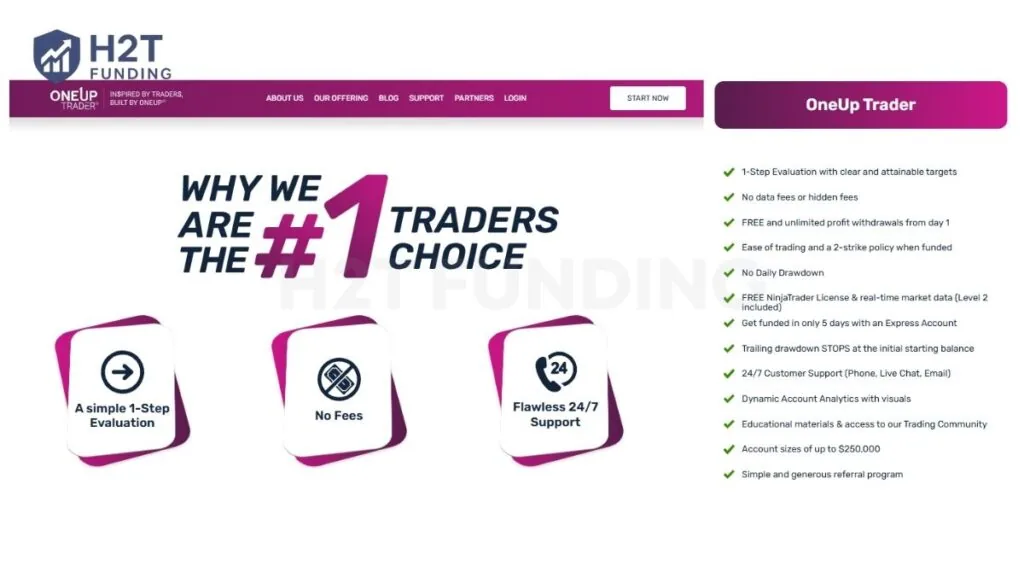
The firm is based in Wilmington, Delaware, and focuses exclusively on CME-listed futures markets, including indices, commodities, and currencies. There is no access to forex spot, stocks, or crypto, which keeps execution aligned with regulated, high-liquidity instruments.
2. Our take on OneUp Trader
OneUp Trader works best for disciplined intraday futures traders who value a simple evaluation and flexible risk handling over aggressive scaling features. Its rules are straightforward, but they require consistency and control; this is not a model that rewards erratic or high-risk trading.
The firm’s biggest advantage is how it handles drawdown and early payouts, while its main limitations come from scaling constraints and consistency rules.
Disclaimer: Rules, pricing, and trading conditions may change over time. Traders should always verify the latest terms directly on the official OneUp Trader websites before purchasing any challenge.
Pros & Cons Analysis
Pros
- Static trailing drawdown: Stops trailing once the balance reaches the starting level, reducing long-term risk pressure.
- No daily loss limit: Allows more flexibility in managing trades across sessions.
- Strong early payout structure: Keep 100% of the first $10,000 in profits.
- Simple one-step evaluation: Faster path to funding compared to multi-phase firms.
- Clear, rule-based system: Easy to understand and execute without hidden conditions.
Cons
- Strict consistency rule: An 80% consistency requirement limits profit concentration from a few large trades.
- No built-in scaling plan: Traders must purchase multiple accounts to increase capital.
- Subscription model: Monthly fees continue until you pass or cancel.
- Futures-only offering: No diversification into forex, stocks, or crypto.
- Requires consistency and discipline: Not suitable for high-variance or “all-in” strategies.
3. OneUp Trader programs
OneUp Trader offers five standard evaluation account sizes and a separate Express Funding path. All accounts follow the same core rules, one-step evaluation, identical trailing drawdown logic, and the same profit split.
3.1. Standard evaluation accounts
All standard evaluation accounts follow the same logic: a trailing drawdown that moves up with your balance and then locks at breakeven. This matters because early profits are still exposed, but once stabilized, your risk stops tightening.
From a structural perspective, the profit target is fixed at 6% across all tiers, while drawdown shrinks as account size increases. This creates a hidden advantage for larger accounts: you need the same percentage return, but you operate with a relatively tighter risk constraint in smaller accounts.
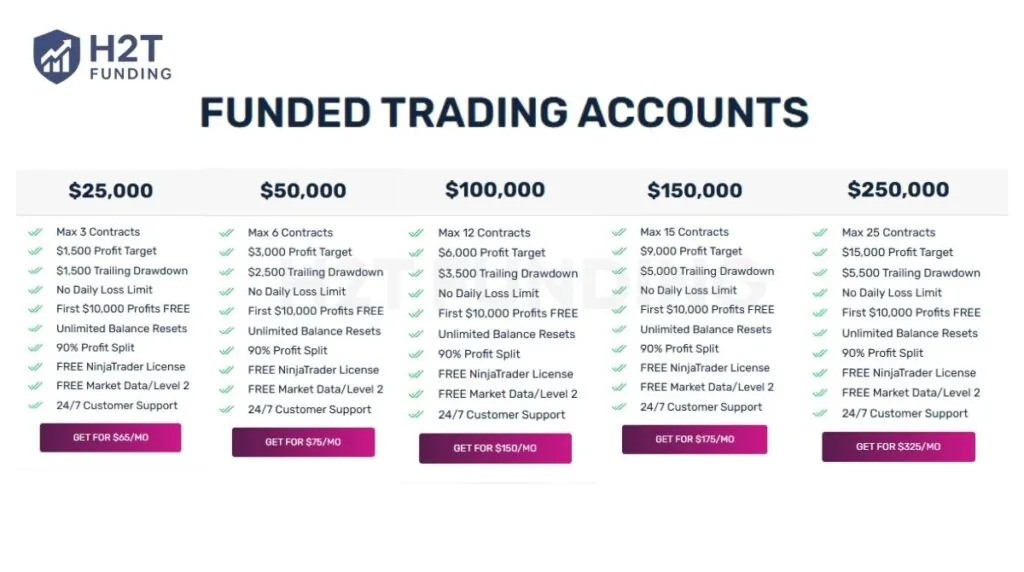
In practice, this means smaller accounts demand precision, while larger accounts allow more room to manage trades and recover from losses.
| Account | Monthly Fee | Profit Target | Trailing Drawdown | Max Contracts |
|---|---|---|---|---|
| 25K | $65 | $1,500 (6%) | $1,500 (6%) | 3 |
| 50K | $75 | $3,000 (6%) | $2,500 (5%) | 6 |
| 100K | $150 | $6,000 (6%) | $3,500 (3.5%) | 12 |
| 150K | $175 | $9,000 (6%) | $5,000 (3.3%) | 15 |
| 250K | $325 | $15,000 (6%) | $5,500 (2.2%) | 25 |
3.2. Express funding account (Fast re-entry model)
Express Funding is not a separate product; it is a compressed re-evaluation path for previously funded traders. The rules do not change, but the time window does.
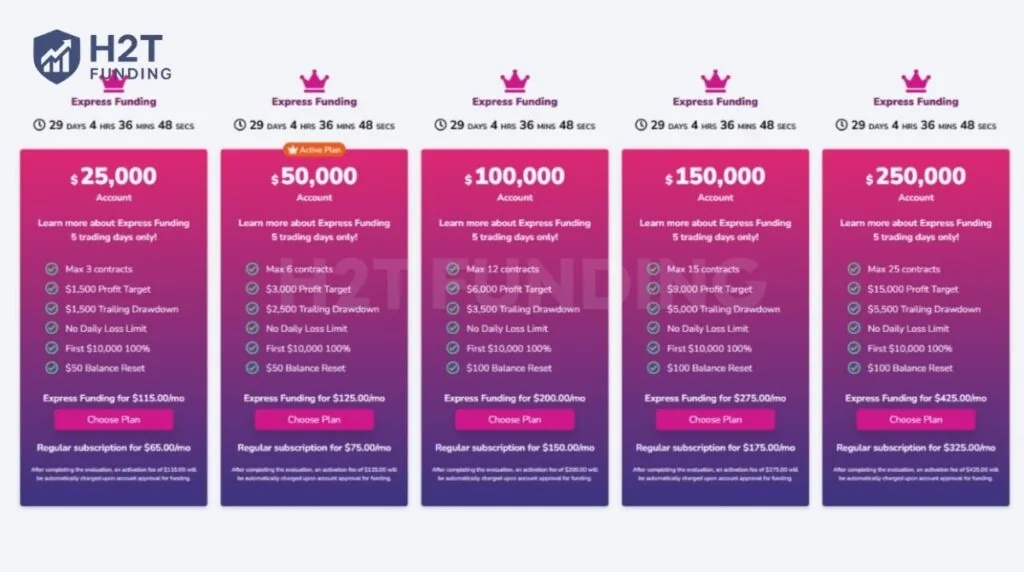
- Eligible only if you lost a funded account within the last 30 days
- Minimum 5 trading days to complete the evaluation
- Must use the same account size as the previously funded account
- Same rules: profit target, trailing drawdown, and consistency requirement
- Only 1 Express account is active at a time
- Maximum 2 attempts within 30 days
The structure assumes the trader already has a working strategy. Instead of repeating the full process, it allows a faster return, but with the same constraints.
Operationally, the environment remains strict. Positions must be closed before the session cutoff, and the consistency rule still forces balanced profit distribution across trading days, preventing one-day spikes from carrying the evaluation.
This makes Express Funding efficient for experienced traders, but unforgiving if discipline is not maintained.
3.3. Which account size is actually optimal?
At a glance, all accounts look similar because they share the same 6% target. The difference becomes clear when you compare how much drawdown you get to achieve that target.
The 25K account has a 1:1 ratio ($1,500 drawdown vs. $1,500 target). This means your loss limit is exactly equal to your profit goal. In practice, this leaves no room for normal trading variance. A small drawdown can end the account before you recover.
The 50K account improves to around 1:1.2 ($2,500 vs. $3,000). The buffer increases slightly, but the structure is still tight. You need controlled execution, as losses still take up a large portion of your allowed range.
The 100K account moves to about 1:1.7 ($3,500 vs. $6,000). This creates a more workable structure. You can take losses and still continue trading without immediately risking the account.
The 150K account is closed at 1:1.8 ($5,000 vs. $9,000). This is similar to the 100K account, offering a stable balance between risk and target.
The 250K account reaches about 1:2.7 ($5,500 vs. $15,000). This is the most favorable setup. Your drawdown is much smaller compared to the profit target, allowing you to build gains over time without hitting the limit too quickly.
In simple terms, the higher the ratio, the more room you have to trade and recover. The 25K account is the most restrictive, while the 250K account gives the most flexibility. The 100K and 150K accounts sit in the middle, where the balance between risk and target becomes easier to manage.
Verdict on OneUp Trader programs
OneUp Trader’s program design is simple on the surface but selective in execution. The rules do not change, but the difficulty shifts based on how much room each account gives you to operate.
- Larger accounts improve survivability through better drawdown ratios
- Mid-tier accounts (100K–150K) offer the most practical balance
- Smaller accounts increase failure risk due to tight constraints
This structure rewards traders who can maintain consistency over multiple sessions. If your strategy depends on controlled risk and steady gains, the model works. If it relies on large, infrequent wins, the constraints will limit your performance.
4. OneUp Trader trading rules
OneUp Trader applies the same rules for both evaluation and funded accounts, which removes uncertainty after passing. The structure is simple, but strict; every rule is tied to risk control, consistency, and capital protection.
4.1. General guidelines & allowed practices
These are the core conditions you must follow to stay compliant and qualify for funding:
- Minimum trading days: At least 10 trading days (or 5 for Express Funding). Days do not need to be consecutive. Weekends and holidays do not count.
- Trading hours: Trading starts at 5:00 PM CT and ends at 3:15 PM CT the next day. All positions must be closed before 3:15 PM CT.
- Permitted products: Trade CME futures only, including indices (ES, NQ, YM), commodities (CL, GC, NG), currencies (6E, 6B, 6J), and micro contracts (MES, MNQ, M2K, MYM).
- Profit target: Fixed at 6% of account size. This is the minimum net profit required to pass.
- Trailing drawdown: The drawdown follows your account balance upward, and locks at the starting balance once reached. You must not hit this threshold at any time.
- Max position size: The number of contracts is capped based on account size. This is the total open exposure across all instruments, not per trade.
- Consistency rule: Your profit must be distributed across multiple days. The combined profit of your next best trading days must reach at least 80% of your best day.
This structure allows flexibility in execution, but it requires controlled position sizing and stable performance over time.
4.2. Prohibited trading practices
These restrictions define what will invalidate your account, focusing on behaviors that increase risk or break the firm’s execution framework.
- Holding trades outside allowed hours: Any open position after 3:15 PM CT is a violation.
- Trading during a restricted time window: No trading is allowed between 3:15 PM CT and 5:00 PM CT.
- Exceeding max contract limits: Opening more contracts than allowed, even briefly, triggers an immediate breach.
- Breaching trailing drawdown: If your account balance hits the drawdown level, the account is terminated or must be reset.
- Failing the consistency rule: Relying on one large winning day without supporting performance across other days will invalidate the evaluation.
Verdict on OneUp Trader trading rules
The rule set is simple on paper, but in practice, it filters out unstable trading behavior very quickly. There are no hidden conditions or sudden rule changes after passing, which makes the environment predictable, but also unforgiving if your execution is inconsistent.
The trailing drawdown is not the main difficulty. Because it locks at breakeven, it becomes easier to manage once you build initial profit. The real pressure comes earlier, when the drawdown is still moving with your balance and can tighten your margin during normal fluctuations.
The consistency rule is the key constraint. It forces you to prove that your edge works across multiple sessions, not just one strong trade.
For example, if your best day is $1,000, then you need at least $800 combined from other top days:
- Scenario 1 (fails): $1,000 -> $300 -> $250 -> $200 = $750 -> below requirement
- Scenario 2 (passes): $1,000 -> $400 -> $300 -> $200 = $900 -> meets requirement
This rule changes how you trade. You cannot rely on one breakout or news trade to pass. You must repeat performance over several days, which naturally limits aggressive strategies.
Another important point is the lack of a daily loss limit. This gives flexibility to manage trades across sessions, but it also means risk is fully controlled by the trailing drawdown. If you mismanage a single session, there is no daily cap to protect you.
5. OneUp Trader payout rules
You cannot withdraw the full account profit. Each account has a minimum profit buffer (threshold) that must remain in the account after withdrawal.
5.1. Profit split structure
The payout model is simple but highly favorable in the early stage of a funded account:
- 100% of the first $10,000 in profits goes entirely to the trader.
- 90% profit split thereafter, with 10% allocated to the funding partner.
This structure gives traders a strong advantage early on, as they can recover evaluation costs and build capital quickly before the standard split applies. For example, if a trader generates $20,000 in profit:
- First $10,000 -> trader keeps 100% = $10,000
- Next $10,000 -> trader keeps 90% = $9,000
- Total payout = $19,000
This front-loaded model increases early-stage profitability compared to typical flat splits.
5.2. Withdrawal thresholds
| Account Size | Withdrawal Threshold | Minimum Request |
|---|---|---|
| $25,000 | $1,500 | $1,000 |
| $50,000 | $2,500 | $1,000 |
| $100,000 | $3,500 | $1,000 |
| $150,000 | $5,000 | $1,000 |
| $250,000 | $5,500 | $1,000 |
This means only profits above the threshold are available for withdrawal.
For example, on a $100K account:
- If you make $6,500 -> eligible withdrawal = $3,000 ($6,500 – $3,500 threshold)
- If your balance reaches $9,500 -> eligible withdrawal = $6,000
The threshold ensures you always leave a buffer in the account after withdrawing.
5.3. Withdrawal process & methods
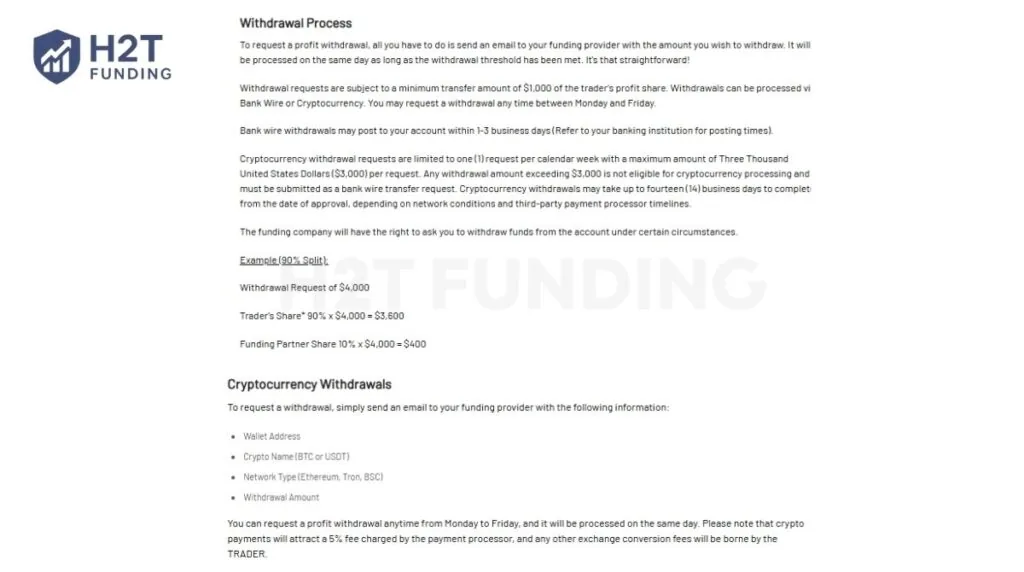
The withdrawal process is straightforward: once your account exceeds the threshold, you can request a payout via email, and it will be processed the same business day (Monday–Friday). The minimum withdrawal amount is $1,000, and the actual speed depends on the payment method you choose.
| Method | Processing Time | Fee | Limit |
|---|---|---|---|
| Bank Wire | 1–3 business days | None | No cap |
| Crypto (BTC/USDT) | Up to 14 business days | 5% (payment processor) | $3,000 per calendar week |
Bank wire is the default option for most traders because it has no limit and faster settlement. Crypto withdrawals offer flexibility but come with stricter conditions, including weekly caps, longer processing times, and additional fees. Any amount above $3,000 must be withdrawn via bank wire.
Verdict on OneUp Trader payout rules
OneUp Trader’s payout system is designed to prioritize early profit access while maintaining account stability through enforced buffers. The structure looks simple, but in practice, it directly shapes how you manage both profits and risk after getting funded.
The strongest advantage is the front-loaded payout model, where you keep 100% of the first $10,000. This allows you to recover evaluation costs quickly and generate real returns early, instead of waiting through multiple payout cycles.
However, the withdrawal threshold changes how much you can actually take out, which is where many traders misjudge the system. Your total profit is not equal to your withdrawable profit, because a fixed portion must always remain in the account.
For example, on a $100K account:
- Total profit: $6,500
- Threshold: $3,500
- Actual withdrawal: $3,000
This gap forces you to leave capital inside the account, which protects against drawdown but slows down full profit extraction.
6. OneUp Trader scaling plan
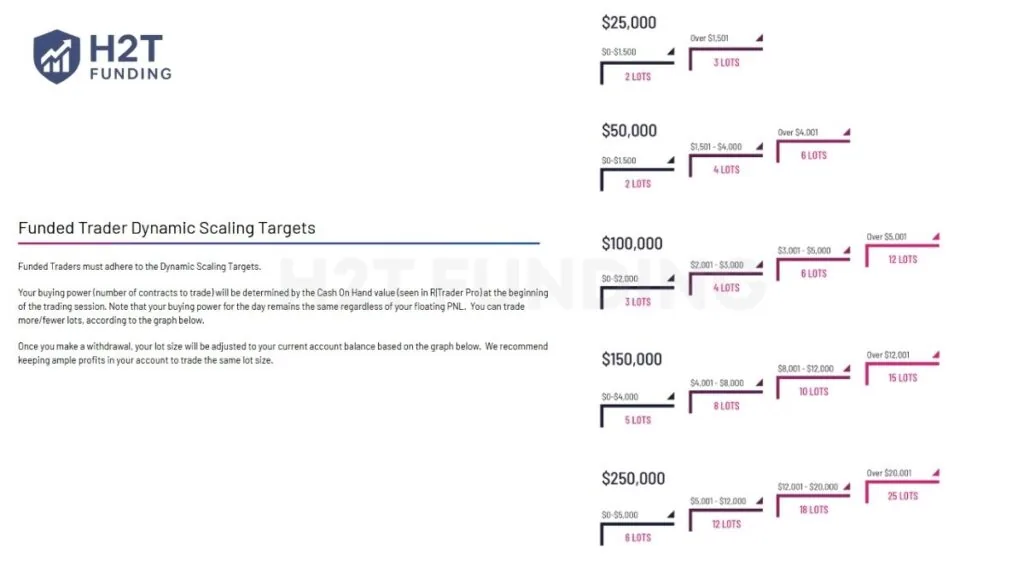
OneUp Trader uses a dynamic scaling model, where your maximum contract size depends on your Cash On Hand at the start of each trading day. Your buying power stays fixed during the session and only updates the next day based on the realized balance. If you withdraw profits, your lot size may decrease accordingly.
| Account | Balance Range | Max Contracts |
|---|---|---|
| $25K | $0 – $1,500 | 2 |
| $1,501+ | 3 | |
| $50K | $0 – $1,500 | 2 |
| $1,501 – $4,000 | 4 | |
| $4,001+ | 6 | |
| $100K | $0 – $2,000 | 3 |
| $2,001 – $3,000 | 4 | |
| $3,001 – $5,000 | 6 | |
| $5,001+ | 12 | |
| $150K | $0 – $4,000 | 5 |
| $4,001 – $8,000 | 8 | |
| $8,001 – $12,000 | 10 | |
| $12,001+ | 15 | |
| $250K | $0 – $5,000 | 6 |
| $5,001 – $12,000 | 12 | |
| $12,001 – $20,000 | 18 | |
| $20,001+ | 25 |
Verdict on OneUp Trader scaling plan
The scaling model is simple: you only trade bigger when your balance actually grows.
- Position size is based on realized balance, not floating profit
- Scaling is step-by-step, not immediate
- Withdrawals can reduce your lot size
This setup supports controlled growth but limits fast scaling. The plan works well for traders who build profit steadily. If you withdraw too early or rely on aggressive sizing, your growth will slow down.
7. OneUp Trader instruments and trading conditions
OneUp Trader provides access to CME-listed futures only, covering major asset classes such as indices, commodities, currencies, rates, and micros, with commissions and fees fully included in your trading results (net P&L).
7.1. Tradable instruments
With a funded account, you can trade over 40 futures contracts, including:
- Equity indices: ES (S&P 500), NQ (NASDAQ 100), YM (Dow Jones), RTY
- Commodities: CL (Crude Oil), GC (Gold), NG (Natural Gas)
- Currencies: 6E (Euro FX), 6B (GBP), 6J (JPY)
- Interest rates: ZN, ZB, ZF
- Micro contracts: MES, MNQ, M2K, MYM
This coverage allows traders to focus on high-liquidity, standardized markets, rather than fragmented or unregulated assets.
7.2. Commission structure
During evaluation, commissions are fixed and predictable:
- $2.50 per side for standard contracts
- $1 per side for micro contracts
All fees, commissions, exchange, routing, and regulatory fees are already included in your net P&L, which is what determines whether you pass.
For funded accounts, commissions vary by instrument (as shown in the table above), but they remain fully integrated into account balance calculations, meaning every trade reflects real cost conditions.
Verdict on OneUp Trader instruments and trading conditions
OneUp Trader keeps its environment focused and consistent by limiting trading to regulated futures markets with transparent cost structures.
- You trade real, high-volume instruments, not synthetic or internal pricing
- Commissions are clearly defined and included in P&L, avoiding hidden costs
- Micro contracts provide a low-risk way to control position size
- The platform and execution environment reflect real trading conditions
At the same time, the limitation to futures only reduces flexibility. There is no access to forex spot, stocks, or crypto, which may not suit traders who rely on multi-asset strategies.
The setup is strong for futures traders who want a clean, realistic environment with predictable costs. If your strategy depends on CME products and controlled execution, this structure works well. If you need broader market access, it will feel restrictive.
8. OneUp Trader trading platform
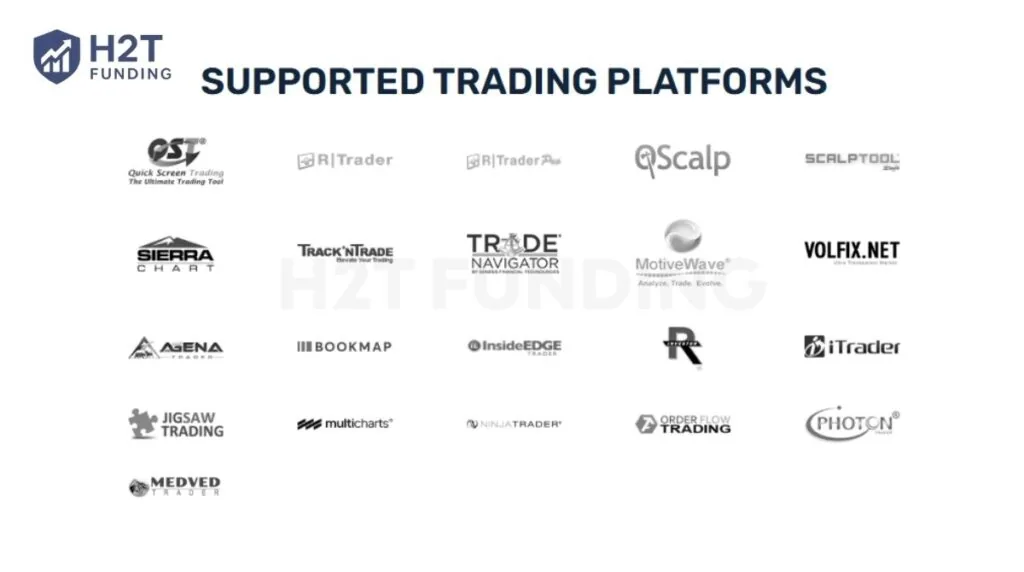
OneUp Trader supports 20+ professional trading platforms, with NinjaTrader provided free during evaluation and included in funded accounts. It is the main platform recommended by OneUp Trader and is suitable for most trading styles, from manual execution to semi-automated strategies. And that includes advanced charting, order flow tools, and trade management features.
A key advantage is cost efficiency. The NinjaTrader license is included, which typically costs over $1,000 for a lifetime license or around $50/month. This removes a common expense that traders face when using futures platforms.
In addition, OneUp Trader supports other tools like ATAS, Quantower, Trade Navigator, VolFix, and more, allowing traders to match the platform with their strategy.
- NinjaTrader
- R|Trader
- R|Trader Pro
- AgenaTrader
- Inside Edge Trader
- R Investor
- MotiveWave
- MultiCharts
- Photon
- QScalp
- QST (Quick Screen Trading)
- ScalpTool
- Track ‘n Trade
- Trade Navigator
- VolFix.net
- eSignal
- Jigsaw Trading
- ATAS Order Flow Trading
- Bookmap
- Quantower
- Sierra Chart
Verdict on the OneUp Trader trading platform
The platform setup is flexible and cost-efficient, but it assumes you understand how to choose and use the right tools.
- Free NinjaTrader reduces the upfront cost
- Wide platform support fits different trading styles
- Rhythmic connection ensures consistent execution
At the same time, having many options increases complexity. Traders who are new may need time to set up and adapt. The platform offering is strong for futures trading. If you want a simple start, use NinjaTrader. If you need advanced tools, the ecosystem supports it.
9. OneUp Trader support and education
OneUp Trader provides 24/7 customer support and built-in educational resources, allowing traders to get help quickly while also improving their trading skills within the same ecosystem.
9.1. Customer support
Support is available across multiple channels, which is less common compared to most prop firms that rely only on ticket systems.
- Phone support: +1 302-231-0217
- Email: support@oneuptrader.com
- Live chat: Available directly on the website
The key advantage is response speed. Traders can contact support in real time instead of waiting 24–72 hours, which is typical in the prop firm space. This becomes important when dealing with account issues, rule clarification, or withdrawal requests.
9.2. Community & Trading Dashboard
OneUp Trader integrates a private trader community dashboard directly into the platform, where traders can interact without leaving the trading environment.
- Post, share, and follow other traders
- Access live community chat
- Track performance and account metrics
- View market news and economic calendar
This creates a centralized workspace where trading, analysis, and communication happen in one place, instead of relying on external tools or forums.
9.3. Educational resources
The educational content is structured for both beginners and experienced traders, with materials available during evaluation and after funding.
- YouTube (Trading Strategies for Beginners): Foundational futures concepts
- YouTube (Top Trading Strategies): Intermediate and advanced setups
- YouTube (Platform Guides): NinjaTrader and platform tutorials
- Help Center: Full documentation on rules, billing, and account setup
The content is produced internally and focuses on practical usage, not just theory, which makes it directly applicable to the evaluation process.
Verdict on OneUp Trader customer service and education
OneUp Trader combines fast support with integrated learning tools, which improve both execution and user experience.
- 24/7 multi-channel support reduces downtime when issues occur
- Phone support is a strong advantage compared to ticket-only systems
- Built-in community and analytics create a more complete trading environment
- Educational content supports traders at different experience levels
At the same time, the resources are focused on practical trading and platform usage, not deep institutional-level education. Advanced traders may still rely on external research or specialized training.
10. Experienced trader feedback on OneUp Trader Trustpilot and OneUp Trader Reddit
As of April 21, 2026, OneUp Trader holds a 4.7/5 rating on Trustpilot from over 2,400 reviews, which places it among the higher-rated futures prop firms. The overall sentiment is positive, but the details behind those ratings show a more balanced picture.
Most positive reviews focus on three consistent points: support, simplicity, and cost. Traders often highlight that the evaluation process is easy to understand, with clear rules and no hidden conditions. The 24/7 customer support is mentioned frequently, especially fast response times via chat and email. Many also note that fees are reasonable compared to other prop firms.
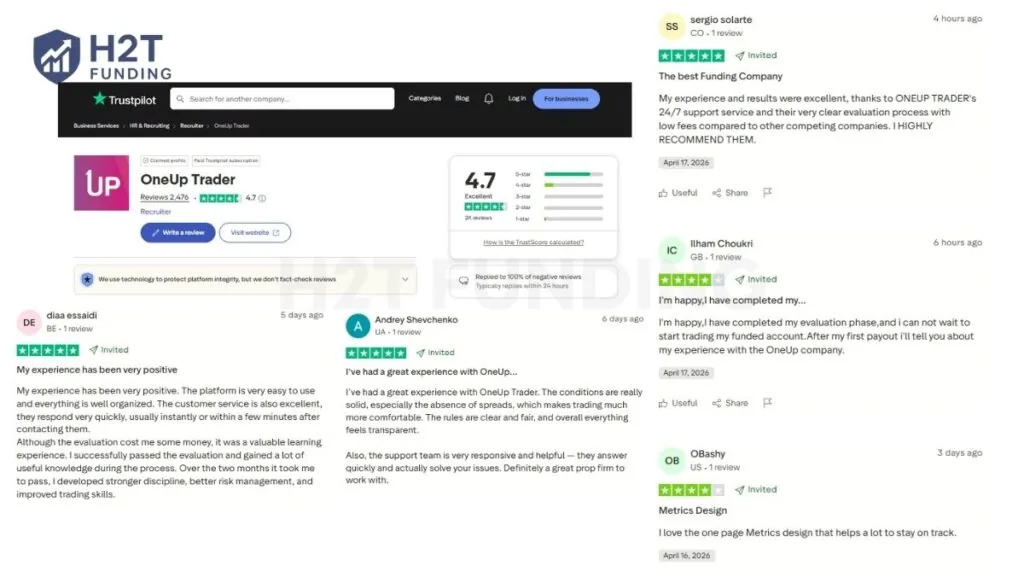
Another common theme is usability. Traders describe the platform as easy to navigate, with a clean dashboard and clear performance tracking. Some reviews also mention that the evaluation helped them improve discipline and risk management, even if they did not pass immediately.
Negative reviews tend to focus on rule enforcement and technical expectations, not scams or missing payouts. The most common complaints include:
- Accounts are being disqualified without warning
- Confusion around contract expiry or trading rules
- Perceived delays or issues with dashboard updates

What stands out is that OneUp Trader actively responds to negative reviews, often with detailed explanations. In many cases, they clarify rule violations (such as trading expired contracts or holding positions past allowed times) and provide references to official documentation. This level of response adds transparency, even when the outcome is not in the trader’s favor.
On Reddit, feedback is more mixed and less structured, but it gives insight into how experienced traders view the firm before joining.
Many traders confirm that:
- NinjaTrader integration works reliably
- Platform connection and execution are stable
- The evaluation is passable with a solid, disciplined strategy
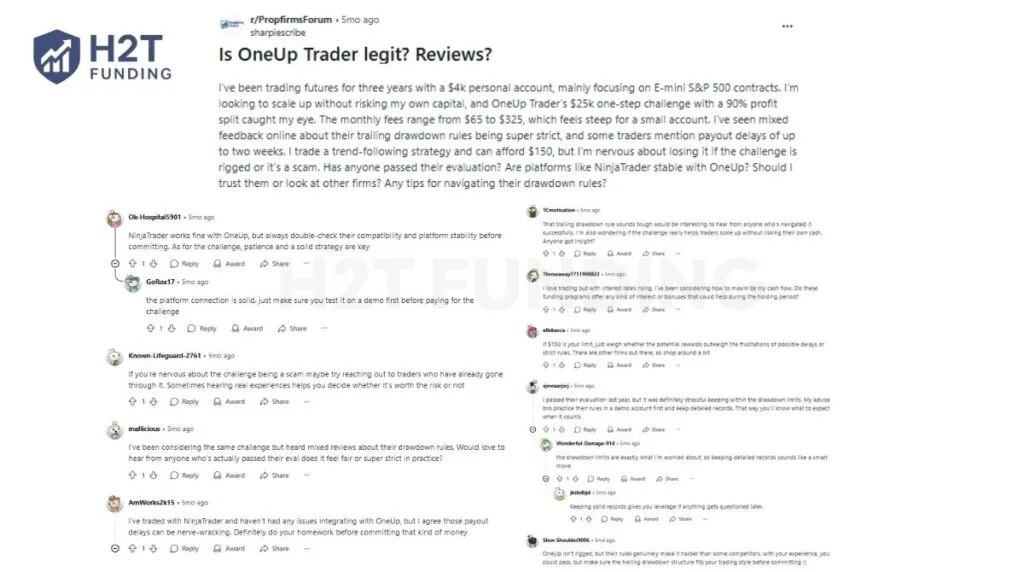
However, concerns often appear around risk rules and expectations. The trailing drawdown is frequently described as strict, especially for traders who are not used to managing floating equity carefully. Some users also mention payout timing concerns, although these are usually based on individual experiences rather than consistent patterns.
OneUp Trader is generally viewed as a legitimate and reliable prop firm. The main risk is not hidden conditions; it is whether your trading style can adapt to their trailing drawdown and consistency requirements.
11. How to sign up for OneUp Trader
The signup process on OneUp Trader follows a clear step-by-step flow and can be completed in just a few minutes.
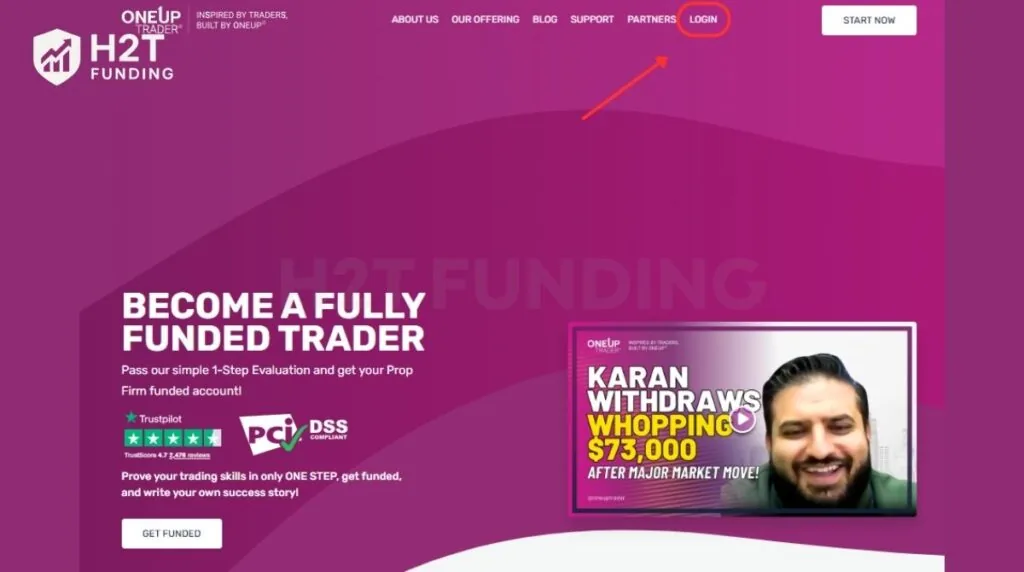
Step 1: Go to the homepage and click the “LOGIN” button in the top-right corner. This opens the account access page.
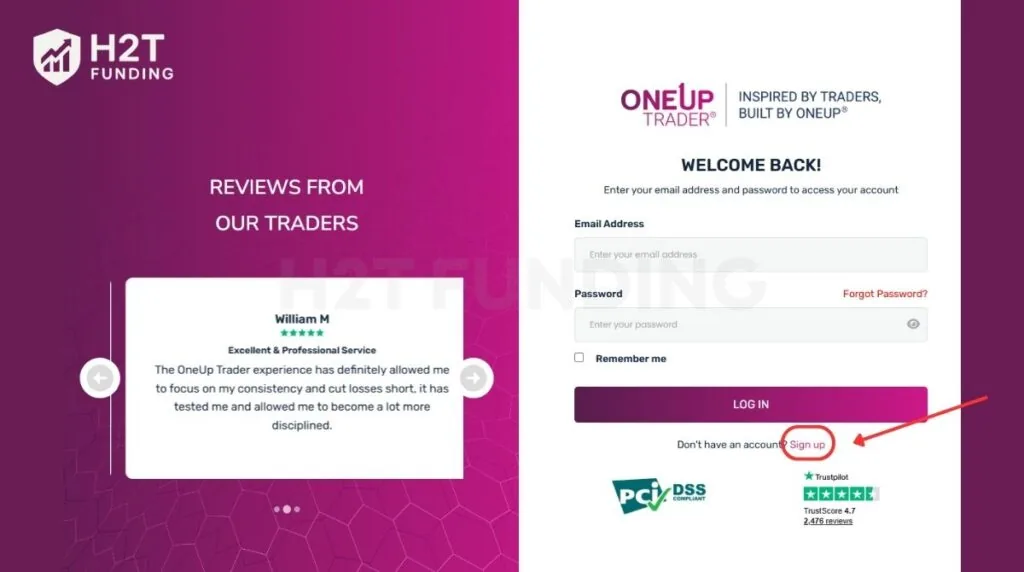
Step 2: On the login screen, click “Sign up” to create a new account instead of logging in.
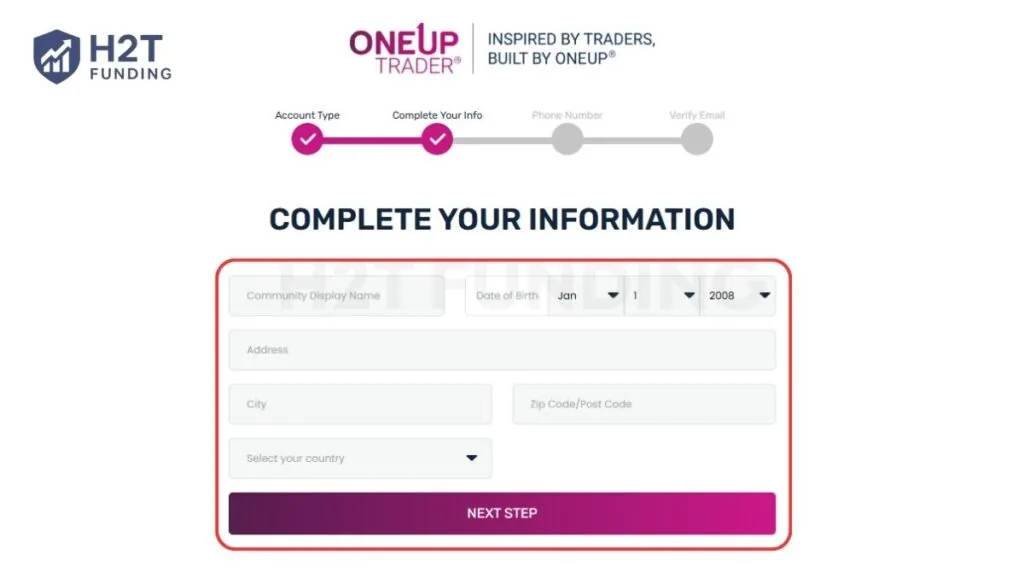
Step 3: Start filling in your personal information, including your display name, date of birth, address, city, country, and zip code. After completing this section, click “Next Step” to continue.
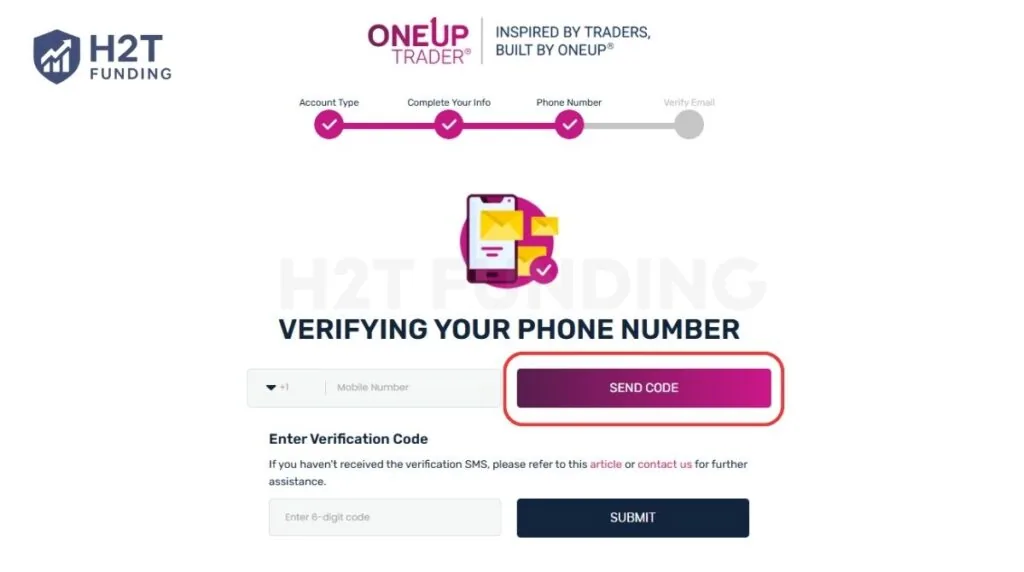
Step 4: Enter your phone number and click “Send Code”. You will receive a 6-digit verification code via SMS. Input the code and click “Submit” to verify your number.
Step 5: Complete the email verification step to activate your account fully. This ensures your account is secured and ready to use.
Step 6: Log in to your dashboard, choose your evaluation plan, connect your trading platform (such as NinjaTrader), and begin trading.
The signup process is simple and guided step-by-step. The only required verifications are basic personal info, phone, and email, making it quick to get started without complex onboarding.
12. OneUp Trader restricted countries
OneUp Trader accepts traders globally, but users from OFAC-sanctioned countries are not allowed to participate. If your country is not available during signup, you will not be able to create an account.
The restricted regions mainly include:
- Afghanistan
- The Balkans
- Belarus
- Myanmar (Burma)
- Burkina Faso
- Burundi
- Cuba
- Central African Republic
- Iran
- Iraq
- Liberia
- Libya
- North Korea
- Sudan
- Somalia
- Syria
- Yemen
- Zambia
- Zimbabwe
- Democratic Republic of Congo
Traders from Ukraine and Russia are still allowed, but participation comes with certain conditions. During evaluation, payments must be made via credit/debit card (Visa, Mastercard, Discover, Amex). After getting funded, withdrawals are typically handled via cryptocurrency (BTC or USDT).
If your country does not appear during the signup process, it usually means you are restricted. In that case, the only option is to contact support directly to confirm eligibility.
13. Compare OneUp Trader review vs other prop firms
If you’re choosing between prop firms, the key differences come down to cost, drawdown rules, payout structure, and trading flexibility. Here’s how OneUp Trader compares directly to its main competitors.
| Feature | OneUp Trader | Apex Trader Funding | Topstep |
|---|---|---|---|
| Markets | Futures only | Futures only | Futures only |
| Evaluation Steps | 1-step | 1-step | 1-step |
| Min. Entry Fee | $65/month | $199 one-time | $49/month |
| Profit Split | 90% (100% first $10K) | 100% (with cap) | 90% |
| Daily Loss Limit | None | None (EOD option) | Yes |
| Trailing Drawdown | Intraday | Intraday / EOD | EOD static |
| Free Platform | NinjaTrader included | NinjaTrader | No |
| Scaling | Dynamic Scaling Targets | Limited (6 payout cap) | Maximum Position Size |
Key differences explained
OneUp Trader focuses on simplicity and flexibility. You get a one-step evaluation, no daily loss limit, and a trailing drawdown that eventually stops moving, which makes risk easier to manage over time.
Apex Trader Funding is more aggressive on paper with a 100% profit split, but it introduces payout caps and stricter conditions that limit how much you can actually withdraw. Topstep adds more structure with a daily loss limit and tighter rules. This can help with discipline but reduces flexibility during trading.
14. Should I choose OneUp Trader?
OneUp Trader is a strong fit if you want a simple, rule-based evaluation with flexibility during intraday trading, especially if your strategy focuses on consistency rather than large, one-off gains.
Choose OneUp Trader if:
- You trade intraday futures only
- You want no daily loss limit
- You prefer a 1-step, easy-to-understand evaluation
- You can maintain consistent performance across multiple days
- You value fast payouts and simple withdrawal rules
Don’t choose OneUp Trader if:
- You rely on one big trade to hit the target
- You prefer aggressive scaling early in the account
- You want to trade forex, stocks, or crypto
- You struggle with trailing drawdown and consistency rules
15. Is OneUp Trader legit?
Yes, OneUp Trader is a legitimate prop trading firm, but it operates under the standard prop firm model rather than as a regulated broker.
The company acts as an evaluation provider and intermediary, connecting traders with funding partners after they pass. This means the evaluation is done in a simulated environment, while funded accounts operate under real market conditions provided by partners.
Key factors supporting its legitimacy include:
- Established presence since 2017 with consistent activity
- 4.7/5 rating on Trustpilot with thousands of reviews
- Transparent rules, publicly available with no hidden conditions
- Real customer support, including phone, chat, and email
- Verified payouts and public trader testimonials
- PCI DSS compliance for secure payment handling
- Registered business address in the U.S.
While some negative feedback exists, it usually concerns misunderstandings about rules or strict enforcement, not missing payouts or fraudulent behavior. The company also responds actively to complaints, often with detailed explanations.
16. FAQs
-
OneUp Trader was founded in 2017 and has been operating in the prop firm space for several years.
-
It offers a 1-step evaluation model and an Express Funding (fast-track re-evaluation) for previously funded traders.
-
Traders keep 100% of the first $10,000 in profits, then 90% thereafter.
-
Account sizes range from $25,000 to $250,000 across five tiers.
-
The drawdown is an intraday trailing drawdown, calculated in real-time and moving up with your balance until it locks at the starting balance.
-
Yes, OneUp Trader news trading is allowed, as long as all other rules (drawdown, position size, trading hours) are respected.
-
The main platform is NinjaTrader (free), with support for others like R|Trader, Sierra Chart, Bookmap, and more.
-
You request withdrawals via email once your account exceeds the withdrawal threshold, and they are processed the same business day.
-
Scaling is dynamic, based on your realized account balance at the start of each day, not floating profit.
-
Only CME futures contracts, including indices, commodities, currencies, and micro futures.
-
Profitability depends entirely on the trader’s strategy, discipline, and risk management, not the platform itself.
-
You pass a 1-step evaluation, then get connected to a funding partner who provides capital for live trading under defined rules.
-
There is no fixed daily loss limit; risk is controlled by the trailing drawdown, which applies at all times.
17. Conclusion
This OneUp Trader review shows that the firm is best suited for futures traders who want a simple, low-cost, and rule-based path to funding. With a one-step evaluation, no daily loss limit, and a trailing drawdown that locks at breakeven, the structure is easy to understand but still strict enough to enforce discipline.
The biggest advantage is the early payout model (100% of the first $10,000), which allows traders to recover costs quickly and generate real returns early. At the same time, rules like the consistency requirement and dynamic scaling limit aggressive, high-variance strategies.
In short, OneUp Trader is not designed for “all-in” trading. It works best for traders who can manage risk consistently and build profits over multiple sessions.
If you’re still comparing options, it’s worth checking other prop firm reviews of H2T Funding to better understand differences in drawdown models, payout structures, and scaling approaches before making a decision.