


Trading attracts many beginners, but most people get stuck at the same question: how to start trading for beginners without making costly mistakes. The problem isn’t a lack of interest, but too much scattered information and no clear starting point.
In simple terms, how to start trading for beginners means learning the basics, choosing one market, practicing with a demo account, and managing risk before using real money. Skipping these steps is the fastest way to lose capital.
This guide, H2T Funding, will break the process down clearly and realistically, focusing on what beginners actually need first. No shortcuts, no hype, just a practical path to help you decide whether trading is right for you and how to begin properly.
Key takeaways:
- Trading is a short-term, active approach focused on profiting from price movements, while investing is a long-term strategy based on holding assets for gradual growth.
- A beginner trader must choose one suitable market (Forex, stocks, indices, commodities, or crypto) based on schedule, capital, and risk tolerance.
- You can start trading with a relatively small amount of capital, often from $100–$500, as long as the money is affordable to lose and used with proper position sizing.
- The basic steps to start trading include learning market fundamentals, choosing one market, practicing on a demo account, creating a trading plan, and starting live with small position sizes.
- Risk is always present in trading, especially with leverage, so using stop-loss orders, limiting risk per trade, and controlling emotions are essential for survival.
- Long-term trading success comes from treating trading like a business, staying patient, keeping a trading journal, and continuously learning from both wins and losses.
1. Start with the right mindset: Trading vs. Investing
Before getting into charts or strategies, it helps to clear up one basic misunderstanding. A lot of beginners run into trouble early simply because they think trading and investing are basically the same thing. They aren’t, and that difference matters more than most people expect.
1.1. Trading vs. Investing: Understanding the core difference
First, let’s clear up a critical misunderstanding: trading is not a faster version of investing. While both aim to make money in the financial markets, they require very different mindsets, skills, and expectations.
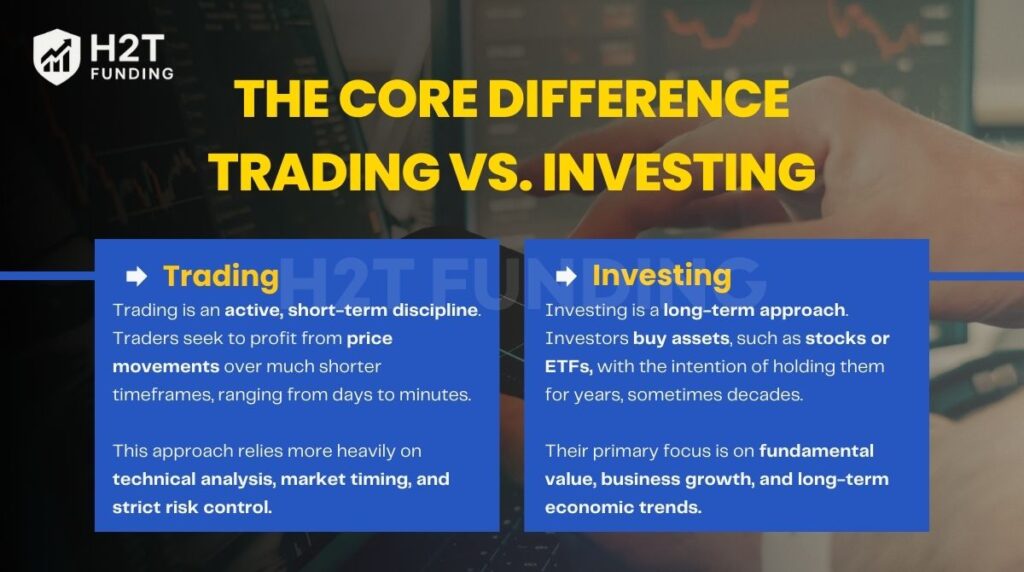
Investing is usually a long-term decision. You buy assets like stocks or ETFs and hold them for years, sometimes longer. Day-to-day price swings don’t matter much. What matters is whether the business or market grows over time.
Trading works in a very different way. It’s much more hands-on. Trades can last days, hours, or even minutes, and losses happen regularly. The focus isn’t on believing in an asset, but on managing entries, exits, and risk.
Where this really shows up is in how each approach feels in practice:
- Investing allows you to step back and be patient.
- Trading forces you to make decisions often, even when you’re unsure.
- Investors can sit through drawdowns; traders usually can’t afford to.
Because of that, trading isn’t automatically the “next step” after investing. If you prefer a slower pace and don’t want to be involved every day, long-term investing often makes more sense at the start. Trading only becomes a good fit once you’re comfortable with frequent decisions, controlled losses, and learning through repetition.
Getting clear on this early saves a lot of frustration and helps you avoid forcing yourself into a style that doesn’t suit you.
1.2. Accepting risk: The #1 rule for every trader
Let me be blunt: trading is a business of managing risk, not just chasing profits. This is the area where most new traders fail, not because their strategy is wrong, but because their approach to risk is.
If you remember nothing else from this guide, remember this: only ever trade with money you are fully prepared to lose. This isn’t just about protecting your bank account; it’s about protecting your mindset. Trading with scared money, funds needed for essentials, triggers fear and leads to poor decisions.
Before you learn any strategy, you must define your personal risk tolerance. Decide exactly how much you’re willing to lose per trade, per day, and overall. Think of risk management not as a restriction, but as the very foundation that allows you to show up and trade another day.
1.3. What trading actually means in practice
Before going any further, beginners need to clearly understand what “trading” actually involves in real market conditions.
In most modern markets, such as Forex, indices, commodities, and even crypto, trading does not mean buying and owning the asset itself. Instead, traders usually speculate on price movements using derivative instruments, most commonly CFDs (Contracts for Difference).
When you trade a derivative, you are simply taking a position on whether the price of an asset will rise or fall:
- You open a buy (long) position if you believe the price will go up.
- You open a sell (short) position if you believe the price will go down.
Your profit or loss depends entirely on how accurate that price prediction is between the moment you open and close the trade.
Most derivative trades are executed using leverage, which allows you to control a large position with a relatively small amount of capital, known as margin. While this lowers the barrier to entry, it also means your exposure is based on the full position size, not just the money you deposit.
This is where risk increases significantly. Leverage amplifies gains, but it also magnifies losses at the same speed. If the market moves against you and your available margin falls below required levels, your broker may issue a margin call or automatically close positions to limit further losses.
For beginners, understanding this mechanism is critical. Trading is not just about predicting direction; it’s about respecting leverage, managing margin, and knowing that even small price movements can have a large impact on your account.
2. Which financial markets can you trade?
With the proper mindset in place, let’s explore your options. From direct stock ownership to complex financial derivatives, there are many ways to trade, but the right market for you is the one that fits your personal style.
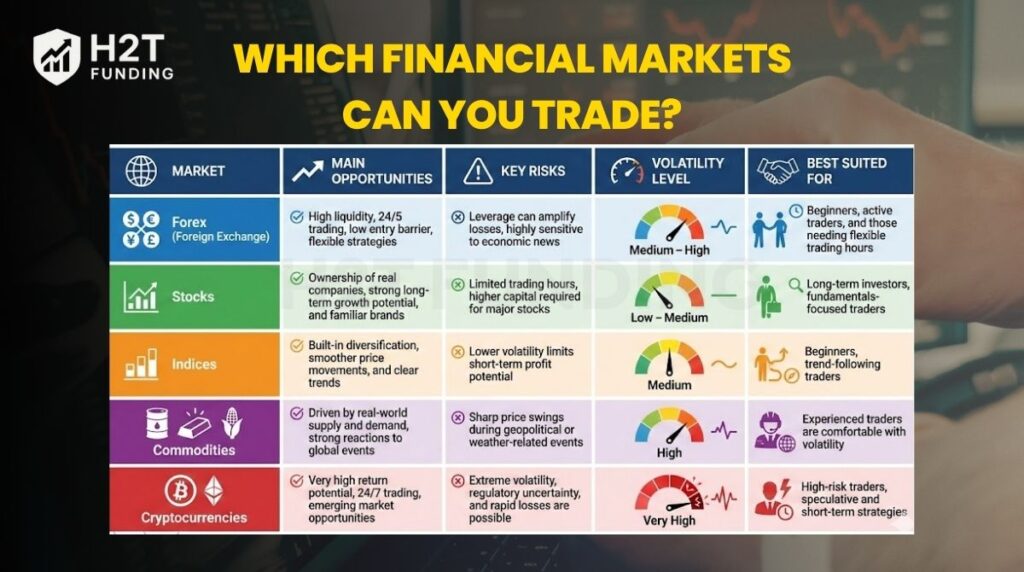
| Market | Main Opportunities | Key Risks | Volatility Level | Best Suited For |
|---|---|---|---|---|
| Forex (Foreign Exchange) | High liquidity, 24/5 trading, low entry barrier, flexible strategies | Leverage can amplify losses, highly sensitive to economic news | Medium – High | Beginners, active traders, and those needing flexible trading hours |
| Stocks | Ownership of real companies, strong long-term growth potential, and familiar brands | Limited trading hours, higher capital required for major stocks | Low – Medium | Long-term investors, fundamentals-focused traders |
| Indices | Built-in diversification, smoother price movements, and clear trends | Lower volatility limits short-term profit potential | Medium | Beginners, trend-following traders |
| Commodities | Driven by real-world supply and demand, strong reactions to global events | Sharp price swings during geopolitical or weather-related events | High | Experienced traders are comfortable with volatility |
| Cryptocurrencies | Very high return potential, 24/7 trading, emerging market opportunities | Extreme volatility, regulatory uncertainty, and rapid losses are possible | Very High | High-risk traders, speculative and short-term strategies |
Continue below to learn how each market works, what drives its price movements, and how beginners can trade it effectively.
2.1. Forex (Foreign exchange): The world’s largest market
The Forex market is the trading place for global currencies, the largest and most liquid financial market in the world. As a trader engaged in forex trading, you speculate on the fluctuating exchange rates between currency pairs, like the Euro and US Dollar (EUR/USD).
One of the first questions beginners often ask is Can you really make money with forex trading. The answer depends largely on your strategy, risk management, and understanding of how the market works.
The biggest attraction it holds is flexibility, since it operates 24 hours a day, five days a week. This accessibility and low entry barrier make forex trading for beginners an especially popular starting point. To trade confidently, it is essential to understand how forex currency trading actually works, including concepts such as currency pairs, spreads, and leverage.
But there is also another important point to remember: leverage can greatly expand your profits or losses. Understanding how to trade forex effectively also means paying attention to how prices are sensitive to global economic news and fluctuating interest rates.
Also, learning how to read currency exchange charts is a fundamental skill that helps traders identify trends, support and resistance levels, and potential entry points.
2.2. Stocks: Owning a piece of a company
Stock trading involves buying and selling shares of publicly listed companies such as Apple (AAPL) or Amazon (AMZN). This is often a more familiar market to a beginner because companies may be household names, and that familiarity can make research feel less intimidating.
The main limitation is that trading is confined to the official hours of the exchange. In addition, buying even a few shares of certain major companies can take more starting capital than in other markets.
2.3. Indices: Trading the entire market
You can trade an index, which represents the performance of a whole group of stocks, such as the S&P 500, instead of betting on a single company. This is one of the most popular ways to speculate on general economic or sector health. Trading indices provides instant diversification, which spreads your risk across hundreds of companies.
Consequently, their price movements tend to be smoother, with clearer trends, and hence easier for novices in trading to analyze. The trade-off here is that they are generally less volatile than individual stocks.
2.4. Commodities: Gold, oil, and beyond
Commodities are raw, physical goods, everything from metals, such as gold and silver, to energy products, like oil, and agricultural goods, like coffee. Their prices are driven by real-world supply-and-demand dynamics, which can be more intuitive for beginners to understand.
For example, a geopolitical event could affect the price of oil, or the price of coffee could be influenced by drought. Its link to real-world events is one of its strengths. However, it also causes prices to move sharply, making the market more volatile.
2.5. Cryptocurrencies: The market of the future?
Cryptocurrencies are decentralized digital assets, and Bitcoin and Ethereum are the leading ones in that regard. This market is famous for its extreme volatility, which offers the potential for very high returns in a short period. It also trades 24/7, including weekends.
On the other hand, this volatility cuts both ways, bringing with it an equally high risk of rapid, significant losses. Novices also need to be aware that regulatory risks continue, with the legal situation for such assets not being settled yet.
Which market is right for you depends upon your personal trading style and risk tolerance. Instead of trying to master all of them at once, a wise approach for a beginner is to choose one market, learn it thoroughly, and build your confidence there first.
3. What do you need to know before starting?
Before you place your first trade, it’s important to understand that trading is not just about charts or indicators. Successful trading requires a solid foundation of knowledge, planning, risk control, and emotional discipline. Taking the time to prepare properly can save you from costly mistakes later on.
3.1. Education & market knowledge
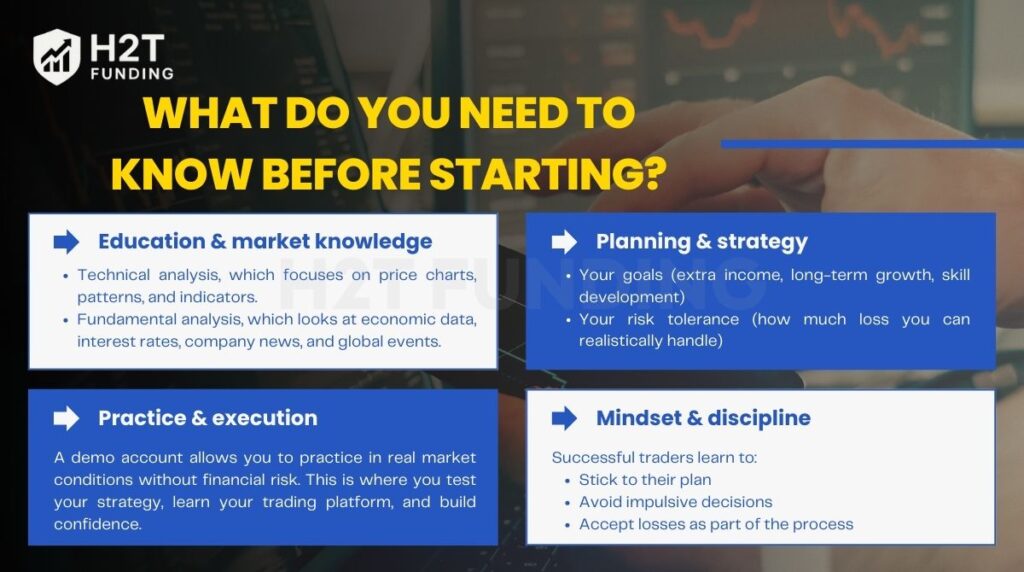
Every trader starts with learning the basics. You need to understand how financial markets work, the key terminology (such as bid, ask, bullish, bearish, leverage), and the differences between asset classes.
Beyond the basics, traders rely on two main forms of analysis:
- Technical analysis, which focuses on price charts, patterns, and indicators.
- Fundamental analysis, which looks at economic data, interest rates, company news, and global events.
You don’t need to master everything at once, but having a working understanding of both gives you a stronger decision-making framework.
3.2. Planning & strategy
Trading without a plan is one of the fastest ways to lose money. Before you start, you should clearly define:
- Your goals (extra income, long-term growth, skill development)
- Your risk tolerance (how much loss you can realistically handle)
A trading plan turns those answers into rules. It should outline your entry and exit criteria, position sizing, and risk management guidelines. At this stage, choosing a reputable broker or prop firm with transparent fees, reliable execution, and the markets you want to trade is also critical.
3.3. Practice & execution
No beginner should start with real money immediately. A demo account allows you to practice in real market conditions without financial risk. This is where you test your strategy, learn your trading platform, and build confidence.
When you eventually move to live trading, start small. Use limited capital and focus on execution, not profits. Proper risk management, such as using stop-loss orders and controlling position size, is essential to protect your account.
3.4. Mindset & discipline
Many beginners underestimate the psychological side of trading. Emotions like fear, greed, and impatience can quickly sabotage even a good strategy.
Successful traders learn to:
- Stick to their plan
- Avoid impulsive decisions
- Accept losses as part of the process
Discipline and emotional control are skills developed over time, and they are just as important as technical knowledge. Finally, remember that markets evolve, and continuous learning is not optional if you want long-term success.
With the right expectations and mindset in place, the next step is to turn these principles into action. In the following section, we’ll walk through a clear, step-by-step guide that shows beginners exactly how to start trading in a structured and disciplined way.
4. 11 crucial steps on how to start trading for beginners
This is where the journey truly begins, answering the fundamental question of trading: how to start?. We’ve broken down the process into 11 manageable steps below:
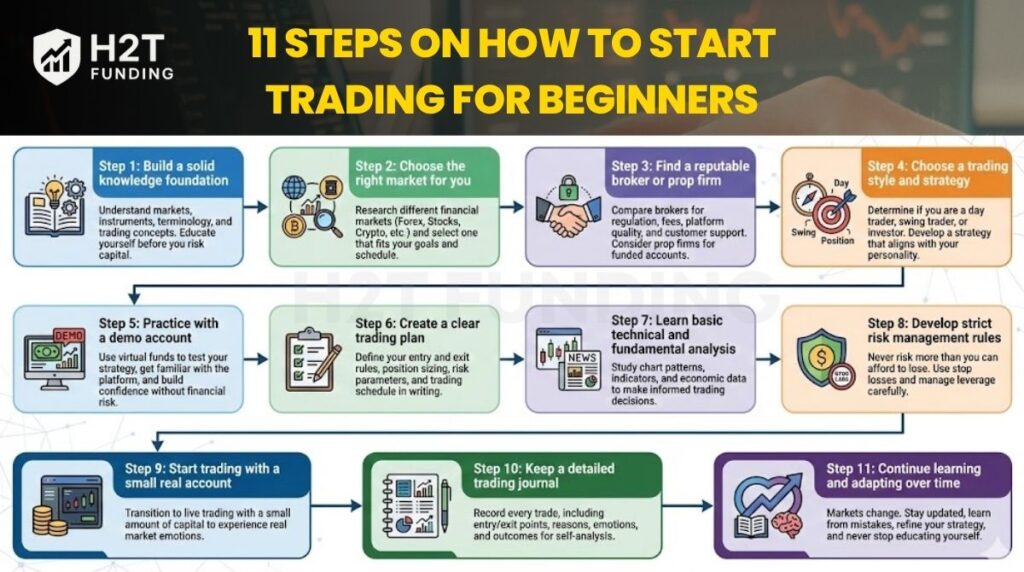
- Step 1: Build a solid knowledge foundation
- Step 2: Choose the right market for you
- Step 3: Find a reputable broker or prop firm
- Step 4: Choose a trading style and strategy
- Step 5: Practice with a demo account
- Step 6: Create a clear trading plan
- Step 7: Learn basic technical and fundamental analysis
- Step 8: Develop strict risk management rules
- Step 9: Start trading with a small real account
- Step 10: Keep a detailed trading journal
- Step 11: Continue learning and adapting over time
Explore each step in detail below and follow them to build confidence, consistency, and proper trading habits as a beginner.
4.1. Step 1: Build a solid knowledge foundation
If you are serious about learning how to learn trading, your journey must begin with a commitment to education. To trade without an understanding of the core concepts is like trying to find your way around a new city without a map. Investment of time upfront to learn will save you significant money and frustration later on.
Start by mastering the fundamental terminology. You need to confidently understand terms like Pip, Lot, Spread, Leverage, Margin, and Derivatives. These aren’t just jargon; they are the building blocks of every trade you will make.
A deep dive into these basic concepts secures your understanding of what happens behind the scenes when you perform trades. Explore educational resources found through well-known sources, dedicated trading books, or comprehensive online courses.
As you build your foundation, understanding tools like the Simple Moving Average vs the Exponential Moving Average helps you read price trends more clearly. Over time, learning how institutional signals such as option block trades work can further deepen your market awareness.
4.2. Step 2: Choose the right market for you
You have gone through various markets and must be thinking which one to choose. This is not about finding the best market but finding which one matches your life and your personality. A particular market that works for a full-time trader may or may not work for you.
- At what time can I actually trade? If you work a 9-to-5 job, a market that is open at fixed hours, such as stocks, may be very hard. Perhaps the 24/5 nature of Forex or the 24/7 crypto market will suit your schedule.
- How much capital can I start with? Some markets, including stocks, may require more capital to get started effectively. In Forex markets, you can start with a much smaller minimum deposit, making it more accessible.
- What is your personality like? If you thrive on lots of fast action, the high volatility of crypto may be for you. If you like to take your time with a more methodical approach to analysis, then trading major indices might suit your temperament better.
Here is the most important advice for any new trader: select one market, and concentrate on that one market only. One of the biggest mistakes made by many traders is diversifying into too many markets, which results in confusion and loss. First, master one arena before considering any other.
For traders considering Forex, understanding what time the Forex market opens and which trading sessions overlap can help you align market activity with your daily schedule and trading style.
4.3. Step 3: Find a reputable broker or prop firm
Your broker or prop firm is your primary partner in trading. Choosing the right one is your main defense against issues like counterparty risk and poor execution related to liquidity risks. Evaluate your options based on these key factors:
- Regulation and security: Is the firm regulated by a top-tier financial authority, such as the FCA, ASIC, or CySEC? It is not up for negotiation that your funds are protected.
- Trading costs: Don’t always believe the figures they advertise. Understand how much they charge: spreads, which are the differences between buying and selling prices; commissions for every trade; and even overnight funding fees. These directly eat into your profitability.
- Trading platform: The platform is your command center. Is it stable, fast, and user-friendly? Does it offer the charting tools and indicators you need? The industry standards are MT4 and MT5. For those planning how to start trading for beginners on mobile, ensure the broker offers a robust and full-featured mobile app for these platforms.
- Customer support: When something is wrong, you want to get reliable help. Verify that they can provide responsive support through live chat, email, or by phone, and test their response time before you commit.
Making this choice can be overwhelming for new traders. To simplify the process, we have created a detailed guide and prop firm review to help you identify the best prop firm for beginners. Check out our detailed reviews to make a truly informed decision.
If you’re unsure where to start, this guide on how to choose a prop firm breaks down the key criteria beginners should evaluate before committing.
4.4. Step 4: Choose a trading style and strategy
Trading styles and strategies play a key role in shaping how often you trade, how long you stay in positions, and how much time you need to spend monitoring the market. For beginners, selecting an approach that matches your daily schedule and experience level is more important than chasing fast results.
Common trading styles
| Trading style | Typical time frame | Holding period | Trading frequency | Suitable for beginners |
|---|---|---|---|---|
| Position trading | Long term | Weeks to months (or longer) | Low | ✅ Yes |
| Swing trading | Medium term | Days to weeks | Medium | ✅ Yes (recommended) |
| Day trading | Short term | Intraday | High | ⚠️ Not ideal |
| Scalping | Very short term | Seconds to minutes | Very high | ❌ No |
Note: Beginners with full-time jobs or limited screen time generally perform better with position trading or swing trading, rather than day trading or scalping.
Common trading strategies
| Trading strategy | Typical use | Timeframe | Commonly used with |
|---|---|---|---|
| Trend trading | Follows market direction | Medium to long term | Position & swing trading |
| Range trading | Trades between support & resistance | Short to very short term | Day trading & scalping |
| Breakout trading | Trades price breakouts | Short to medium term | Day & swing trading |
| Reversal trading | Trades market turning points | Varies | Swing & position trading |
As a beginner, it’s best to focus on one simple, rule-based strategy that fits your chosen trading style. Consistency in execution matters far more than using multiple strategies at once.
4.5. Step 5: Open a demo account – practice risk-free
A demo account is your personal flight simulator, and it’s a critical tool in learning how to trade as a beginner. It allows you to apply the trading style and strategy you’ve chosen in real market conditions, without risking real money. So you can focus on execution, discipline, and consistency before moving to a live account.
The primary goal here is twofold:
- Master your platform: Learn exactly how to open, modify, and close trades. Practice setting a stop-loss order and a take-profit target. Getting comfortable with the mechanics now prevents expensive fat-finger errors later.
- Test your strategy: This is where you can test your trading ideas without any financial consequences. You can see how your strategy performs in different market conditions, helping you build confidence in your approach.
Try to stay in a demo account for at least one to three months. You should only be looking to move on from this step when you are reliably consistent in your results, simulated, of course, and then move into trading with real capital.
4.6. Step 6: Create your trading plan
Trading without a plan is not trading; it’s gambling. A trading plan is your personal business plan for the markets. It is a written set of rules that defines every aspect of your trading activity, created before entering the heat of the market. Its primary job is to keep you disciplined and prevent emotional, impulsive decisions.
At a minimum, it should answer these critical questions:
- Your entry criteria: Under what specific technical or fundamental conditions do you enter a trade? Put it on paper. For example, this may be “I will buy EUR/USD only when the price crosses above the 50-day moving average on the 1-hour chart.”
- Your exit strategy (for profits and losses): At what price level will you take your profits? More importantly, at what price will you accept a loss? This is your stop-loss order, and it is non-negotiable.
- Your risk management rules: How much of your account will you risk on a single trade? A common rule for beginners is to never risk more than 1% of their total capital. This defines your position sizing. What is your minimum acceptable risk/reward ratio?
- The assets and timeframes you will trade: Which specific currency pairs, stocks, or commodities will you focus on? Which chart timeframes will you use for your analysis?
The market will constantly tempt you to break your rules to chase a trade you missed or hold onto a losing position in the hope it will turn around. Your trading plan is your defense against these impulses.
Think of it this way: Your trading plan is your boss. Your only job is to execute its instructions, no matter how you feel in the moment.
4.7. Step 7: Learn basic analysis skills
Once you have a plan, you need a method to identify trading opportunities. In the markets, there are two primary schools of thought for analyzing assets: technical analysis and fundamental analysis. You don’t need to be a Wall Street expert in either, but understanding the basics of both will give you a significant edge.
4.7.1. Technical Analysis
Technical analysis is the study of price charts. The core idea is that all known information is already reflected in an asset’s price, and that price movements tend to follow patterns and trends. As a technical analyst, your job is to read these patterns to predict future price direction.
What you should focus on as a beginner:
- Support and resistance: Learn to identify key price levels where the market has historically reversed or stalled, as these zones are crucial for strategies like breakout trading.
- Trends: Is the market in an uptrend (higher highs and higher lows), a downtrend (lower highs and lower lows), or moving sideways (range trading)? Strategies like trend trading, which involves following the market’s main direction, are often the safest approach for beginners.
- Basic indicators: Start with one or two simple indicators, like Moving Averages or the Relative Strength Index (RSI), to help confirm your analysis. Don’t clutter your charts with dozens of indicators.
4.7.2. Fundamental Analysis
Fundamental analysis, on the other hand, involves looking at the economic, social, and political forces that drive supply and demand. Instead of looking at charts, you are looking at the underlying health of a country’s economy (for Forex) or a company’s performance (for stocks).
What you should focus on as a beginner:
- Economic calendar: Get familiar with a reliable economic calendar. Pay close attention to major news releases like interest rate decisions, inflation reports (CPI), and employment numbers (NFP).
- Understand high-impact news: You don’t need to be an economist, but you should know which news events are likely to cause significant market volatility. Often, the wisest move for a beginner is to avoid trading right before or after these major announcements.
Many successful traders use a combination of both. They might use fundamental analysis to get a big-picture view of the market’s direction and then use technical analysis to find the precise entry and exit points for their trades.
4.8. Step 8: Develop a strict risk management strategy
Let me be very clear: this step is the single most important part of your entire trading career, especially when using tools like leverage and margin. It is the one that will determine whether you succeed or fail in the long run.
From my experience, these three pillars are non-negotiable for any serious trader:
- The 1% Rule: This is your golden rule. It means you will never risk more than 1% of your total account balance on a single trade. If you have a $1,000 account, your maximum acceptable loss on any given trade is $10. This ensures that no single loss, or even a string of five losses, can cripple your account.
- Always use a stop-loss order: A stop-loss is an automatic order that closes your trade at a predetermined price to prevent further losses. Think of it as your seatbelt; you put it on before you start the car, every single time. Trading without a stop-loss is not an option; it is a recipe for disaster.
- Define your Risk/Reward ratio: Before you even enter a trade, you must know your potential profit target versus your potential loss. Aim for a risk/reward ratio of at least 1:2. This means for every $1 you risk, you are aiming to make at least $2. This powerful principle allows you to be wrong more often than you are right and still be a profitable trader.
A well-defined risk strategy is the foundation of emotional discipline. It takes the guesswork and fear out of trading because you know exactly what your maximum loss will be before you ever click the buy or sell button. This is not just a set of guidelines; this is the professional’s code of conduct.
For beginners, following a structured approach like the best trading strategy for beginners can help apply these risk rules consistently without overcomplicating decisions. As you gain experience, learning how to trade using indicators can further support disciplined entries and exits that align with your risk management plan.
4.9. Step 9: Start trading with a real account (Small capital)
This step is the practical answer to the common question of how to start trading for beginners with little money. After consistent practice on a demo account, you transition to the live market not to get rich, but to experience the real psychology of having your own capital at risk.
Even a small amount of money on the line changes everything. The emotions of greed and fear, which were dormant during demo trading, will suddenly become very real. This is a critical part of your education that no simulator can teach you.
Follow these rules to make this transition as smooth and safe as possible:
- Start with the smallest amount possible: Begin with an amount of money that is significant enough for you to care about, but small enough that losing it entirely will not cause any financial or emotional distress. This could be $100, $200, or whatever fits your personal risk tolerance.
- Cut your position size down: If you were trading one standard lot on your demo account, start with a micro lot (0.01 lots) on your live account. Your initial trades should be focused on executing your plan perfectly under pressure, not on the profit and loss.
- Focus on the process, not the profits: For your first 50-100 live trades, your only goal is to follow your trading plan with perfect discipline. Did you enter when your rules said to? Did you set your stop-loss correctly? Did you exit without hesitation? Judging your success by your adherence to the plan, not the monetary outcome, builds the habits of a professional.
This phase is your final training ground. It’s about bridging the gap between theory and reality, and learning to manage your own emotions when real money is at stake.
4.10. Step 10: Keep a trading journal
If you are serious about becoming a successful trader, a trading journal is a mandatory tool for professional development. A trading journal is where you document and review every single trade you take. It forces you to move from random actions to a structured, analytical approach.
Your journal entries don’t have to be complex. For each trade, simply record:
- The setup: Why did you take this trade? What were the specific technical or fundamental reasons for your entry? Capture a screenshot of your chart at the moment of entry.
- The execution: What was your entry price, stop-loss level, and profit target? How was your position sizing calculated?
- The outcome: What was the final profit or loss? How and why did the trade end? Did you follow your plan, or did you make an emotional decision?
- The lesson: What did you do well? What could you have done better? This is the most important part. It’s where you identify patterns in your behavior, both good and bad (e.g., I consistently move my stop-loss on losing trades, or my best trades always follow my initial analysis).
Review your journal every single weekend. This regular self-assessment is the fastest way to identify your strengths, correct your weaknesses, and accelerate your learning curve. Without a journal, you are simply guessing. With one, you are building a data-driven path to improvement.
4.11. Step 11: Always keep learning and adapting
Crossing the finish line of this 10-step guide is not the end of your education; it is the beginning. The financial markets are not static. They are a dynamic, constantly evolving environment, and the strategies that work today might not work tomorrow.
Here’s how you can build this habit of continuous improvement:
- Read voraciously: Follow reputable financial news sources, read books on trading psychology and advanced strategies, and stay engaged with market analysis from trusted experts.
- Stay curious: Always ask why. Why did the market react that way to a news release? Why did that particular chart pattern fail? A curious mind is a learning mind.
- Adapt your strategy: As you gain experience, you will learn what works for your personality and what doesn’t. Don’t be afraid to tweak and refine your trading plan based on the data from your journal. Your strategy should evolve as you do.
Embrace the journey of constant learning, and you will give yourself the best possible chance of thriving in the markets for years to come.
5. The deciding factor – Trading psychology & discipline
One of the most important realities of trading is that even a well-designed strategy can experience losses. The real battle isn’t against the market; it’s against the powerful emotions of greed and fear inside your own mind. This is where most traders fail.
- Greed makes you break your rules. It tempts you to chase oversized profits, over-leverage, or take unplanned trades.
- Fear makes you hesitate. It causes you to exit winning trades too early or hold onto losing trades, hoping they will reverse.
This is why emotional discipline is not optional. Discipline means following your trading plan exactly as written, regardless of how you feel in the moment. Your plan was created when you were calm and objective; your only job during live trading is execution.
For beginners, controlling psychology comes down to a few non-negotiable behaviors:
- Accept the potential loss before entering every trade
- Use a stop-loss on every position to remove emotional decision-making
- Keep position sizes and leverage small enough that losses remain manageable
- Stop trading for the day when your plan tells you to, especially after losses
Trading psychology is not something you master once. It requires constant management throughout your entire trading journey. Even experienced traders rely on strict routines, trade limits, and regular self-review to stay disciplined.
You cannot control the market, but you can always control your risk, your behavior, and whether you follow your plan. Mastering this control is what separates traders who survive long enough to improve from those who burn out early.
6. How much do you need to start trading?
This is one of the most common questions, and the honest answer is: it depends entirely on your goals and the market you choose. There is no single magic number, but you can get started with less than you might think.
- For learning: If your main goal is to gain real-world experience, starting with $100 to $500 is often enough. This amount is perfect for understanding market psychology without significant financial risk.
- For serious trading: To trade with more flexibility and better risk management, a starting capital of $1,000 to $5,000 is a more realistic range for markets like Forex or swing trading stocks.
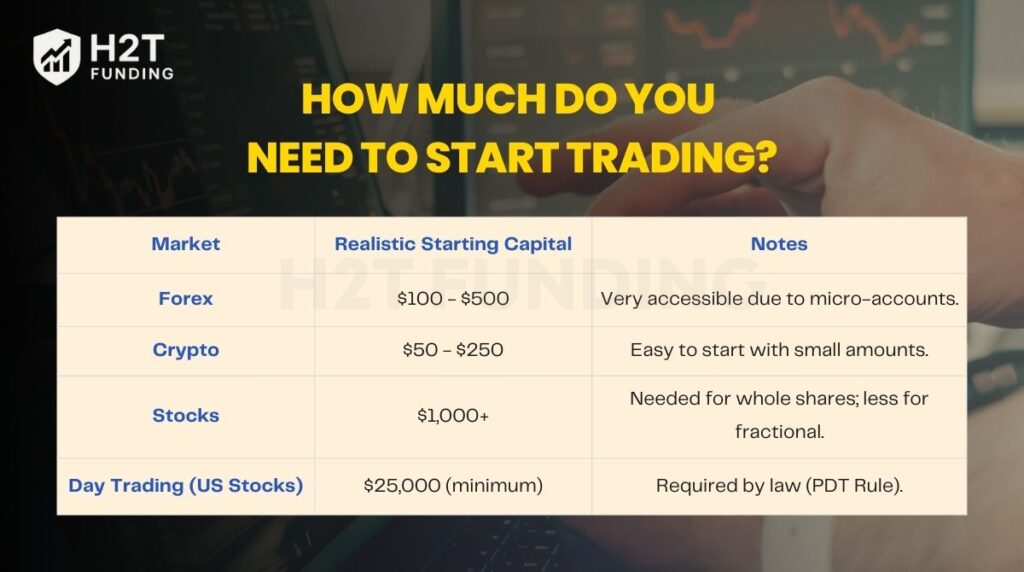
Here’s a quick breakdown by market:
| Market | Realistic Starting Capital | Notes |
|---|---|---|
| Forex | $100 – $500 | Very accessible due to micro-accounts. |
| Crypto | $50 – $250 | Easy to start with small amounts. |
| Stocks | $1,000+ | Needed for whole shares; less for fractional. |
| Day Trading (US Stocks) | $25,000 (minimum) | Required by law (PDT Rule). |
(Note: Non-US traders using CFDs can start with significantly less)
Ultimately, the best approach is to start small, prove your strategy is consistently profitable, and then gradually add more capital as your confidence and skills grow.
7. Common risk you always face when trading
Understanding risk is what separates professional traders from gamblers. While trading offers opportunities, it’s crucial to be aware of the constant challenges you will face. Acknowledging these risks is the first step to managing them effectively.
Here are the most common risks inherent in trading:
- Market risk: This is the most fundamental risk: the price of the asset you are trading might move against your position. No strategy is foolproof, and accepting that you will have losing trades is a core part of the business. Your job is not to avoid losses, but to ensure your wins are bigger than your losses.
- Leverage risk: Leverage is a powerful tool that allows you to control a large position with a small amount of capital. However, it is a double-edged sword. It magnifies your profits, but it also magnifies your losses just as quickly. Misunderstanding and misusing leverage is the single biggest reason why new traders lose their capital.
- Psychological risks: Often, the biggest risk comes from within. The emotions of fear and greed can compel you to abandon your well-made trading plan, leading to impulsive decisions. This is the risk of self-sabotage, and it can only be managed with strict emotional discipline.
- Liquidity risk: This is the risk that you won’t be able to exit your trade at the price you want. During major news or in thin markets, there may be too few buyers or sellers. This can cause significant slippage and lead to bigger losses than expected.
Successful trading is not about avoiding these risks; that’s impossible. It’s about knowing they exist and having a solid plan to manage them every single day.
8. Tips for trading success
From long-term observation within the trading community, success is rarely about finding a secret formula. It comes down to a handful of professional habits that the winners share. If you focus on these, you’ll be miles ahead of the competition.
Below are core principles that are widely emphasized by experienced traders:
- Treat trading like a business, not a hobby. A business has a plan, tracks expenses (losses and fees), and reviews performance. Approach the markets with the seriousness of an entrepreneur, and you will immediately separate yourself from the 90% who fail.
- Master the art of doing nothing. This may sound strange, but the most profitable action you can take on most days is to not trade at all. Your job is to wait patiently for a high-probability setup that matches your plan. Forcing trades on low-quality setups is the fastest way to drain your account.
- Become a master of defense, not offense. Your first and most important job isn’t to make money; it’s to protect the capital you have. Anyone can get lucky on a few trades. Professionals, however, are experts at managing risk, cutting losses quickly, and ensuring they can trade again tomorrow.
- Review your trades religiously. The market is constantly providing you with lessons. Your trading journal is where you write them down so you don’t have to pay for the same lesson twice. Spend time every weekend reviewing your wins and, more importantly, your losses.
- Be aware of counterparty risk: Always remember that your broker is your partner. Choosing a well-regulated broker, as mentioned in Step 3, is your primary defense against the risk that the other party fails to meet their obligations.
Look, trading success is a marathon of discipline, not a sprint for quick cash. If you can shift your focus from making money to flawlessly executing these professional habits, the profits will eventually take care of themselves.
9. How to start trading Reddit insights
Sometimes the best lessons aren’t found in textbooks but in candid conversations within the trading community. I’ve spent time browsing forums like Reddit to see what real traders, people who are living this journey, have to say about getting started. What I found wasn’t complex strategies, but raw, invaluable truths.

Across many threads, traders repeatedly point out that success isn’t about being right all the time. It’s about controlling emotions and managing risk. Books like Trading in the Zone are often recommended, while traders warn beginners to stay away from anyone constantly showing off huge profits, because that’s not the reality of the game.
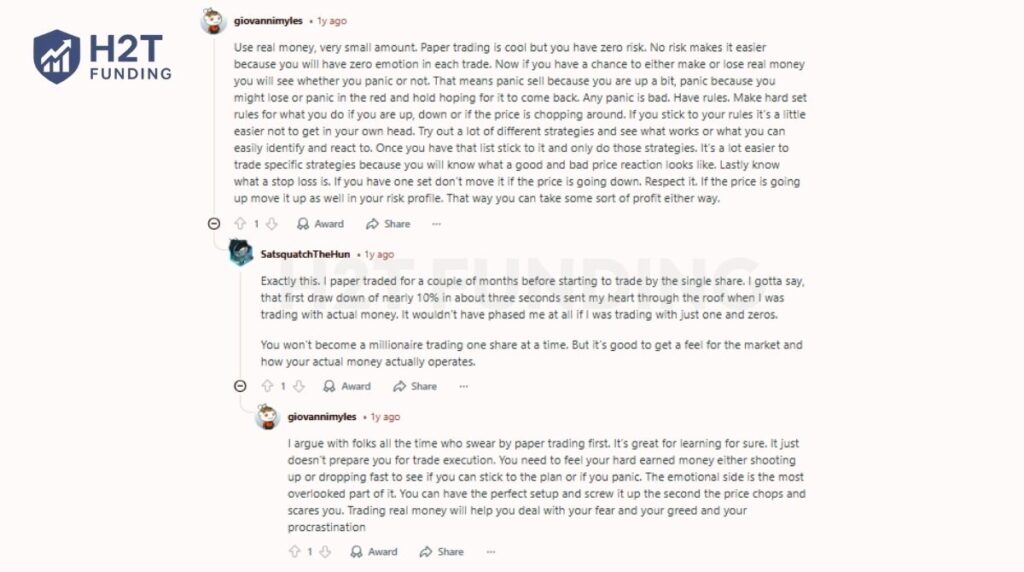
When it comes to practice, the community consensus is less about where you start and more about how you manage risk. Whether using a demo or a small live account, traders stress the importance of treating every trade seriously and protecting capital above all else.
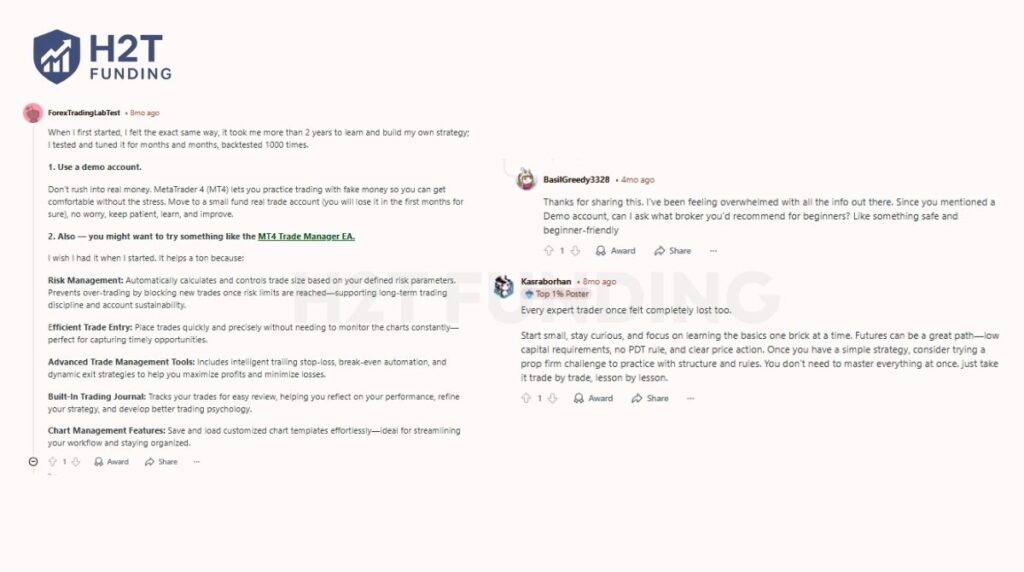
Finally, the clearest message from those who have walked the path is patience. One trader shared that it took him over two years just to fine-tune his strategy on a demo account. This is not a race.
For those asking how to start trading for beginners with no money, taking on a prop firm challenge is often recommended. It’s a great way to access trading capital without risking your own.
In short, the collective wisdom from the trading community boils down to this: Focus on mastering yourself before you try to master the market. Find the practice method that works best for you, whether it’s a demo or a micro-live account. And above all, treat this as a marathon, not a sprint.
10. FAQs
The capital you need depends on your trading style. You can begin learning with just a few hundred dollars, while short-term strategies like scalping usually require around $500–$2,000. Medium-term swing trading works better with $1,000–$5,000, and long-term position trading often needs $5,000 or more. The safest approach is to start with an amount you can afford to lose while you build skill and consistency.
Yes. Thousands of traders are self-taught through free online resources, demo accounts, and structured practice. What matters most is consistency, journaling, and sticking to one strategy until you master it.
Most beginners need 6–18 months to achieve consistent profitability. The timeline depends on how often you practice, whether you journal trades, and how well you manage risk.
No. Gambling relies on random chance. Professional trading is a business based on a statistical edge, where a proven strategy is executed with strict risk management rules over time to produce a positive expected return.
The Forex market is often recommended due to its 24-hour access, high liquidity, and the ability to trade with small amounts of capital (micro-lots). Trading major stock indices like the S&P 500 is also a great choice due to its clear trends and inherent diversification.
Follow a simple, three-stage process: 1) Educate yourself on the fundamentals. 2) Simulate your strategy on a demo account until you can follow your rules consistently. 3) Execute by starting small on a live account with money you can afford to lose.
Yes, but this is a function of your account size and skill. Professional traders often aim for 2-5% monthly returns. To make $1,000 consistently, you would realistically need an account size between $20,000 and $50,000. It is an advanced goal, not a typical beginner’s result.
Yes, $100 is enough to start your education in the live markets. The goal is not to make a fortune but to experience the real psychology of risk and execution. It’s a low-cost way to get invaluable hands-on experience.
This is an extremely unrealistic and dangerous goal for anyone but elite professionals with very large capital accounts (well over $100,000). A 1% daily gain on a $100,000 account is $1,000. Chasing this goal will lead to reckless trading.
The 3-5-7 rule is a risk management framework used by some aggressive traders. It dictates risking a maximum of 3% per trade, keeping total exposure below 5%, and aiming for a 7% profit target. However, as a beginner, we strongly recommend sticking to the 1% rule mentioned in Step 7 until you are consistently profitable.
11. Conclusion
You now have a complete roadmap for how to start trading for beginners. Success is about the disciplined execution of your plan and a deep respect for risk management.
As you master the basics, your focus will naturally shift to leveraging capital and refining your technique. This is the next stage of your evolution as a trader.
To explore this, dive into our Prop Firm & Trading Strategies section of H2T Funding to sharpen your edge with the advanced techniques. Use this knowledge as your foundation, stay disciplined, and trade smart.