

To answer the core question, how much is a pip in forex trading? A pip is the smallest standard unit of price change, typically 0.0001 for most currency pairs like EUR/USD. Its actual monetary value, or pip value, depends on your trade size (lot size).
For a standard lot (100,000 units), one pip is worth about $10 USD. In this guide, H2T Funding will show you exactly how to calculate this value to manage your potential profit and risk effectively.
Key Takeaways
- What is a Pip? It represents the smallest standardized unit of price movement in the forex market.
- A pip is 0.0001 for most pairs (like GBP/USD) and 0.01 for Japanese Yen (JPY) pairs.
- Pip value depends on the specific currency pair, your chosen lot size, and your trading account’s base currency.
- Quick Rule of Thumb (for USD Accounts):
- Standard Lot (1.0): 1 pip ≈ $10
- Mini Lot (0.1): 1 pip ≈ $1
- Micro Lot (0.01): 1 pip ≈ $0.10
1. What exactly is a pip in forex trading?
A pip, short for Percentage in Point, is the standardized way to measure how much an exchange rate has changed within the broader context of how forex currency trading works. Understanding this unit is the first step to quantifying market movements on a chart, creating a universal metric for all traders.
1.1. The standard rule: 4 decimal places
For most major currency pairs, the pip is the fourth digit after the decimal point. This is the market convention for pairs like the EUR/USD, AUD/USD, and GBP/USD. This precise measurement allows traders to track even a minor price move.
For example, if the EUR/USD moves from 1.1050 to 1.1051, it has moved up by one pip.
1.2. The exception: Japanese Yen (JPY) pairs
The main exception to the four-decimal-places rule involves the Japanese Yen. Because of the yen’s different value structure, JPY pairs are quoted to only two decimal places. In this case, the pip is the second digit.
For instance, if USD/JPY moves from 145.50 to 145.55, that represents a move of five pips.
1.3. Understanding pipettes (Fractional pips)
To provide even more pricing precision, many brokers now show fractional pips, often called a pipette. A pipette is simply one-tenth of a pip and appears as a fifth decimal place (or a third for JPY pairs).
If you see a quote for GBP/USD at 1.25005, the small ‘5’ at the end is the pipette. While useful for high-frequency trading strategies, most traders focus on the full pip for their core pip calculation.
2. How much is a pip worth?
The monetary value of a pip is not a fixed number; it is determined by three critical factors in your trade setup. Understanding this is key to managing your funds and answering the question of how much is a pip in forex. The final trade value of any position is a direct result of these elements.
2.1. Factor 1: The currency pair you trade
The specific currency pair you are trading directly influences the pip’s value. This is because the value is calculated based on the quote currency (the second currency listed in a pair). For example, in EUR/USD, the value is denominated in USD. For AUD/CAD, the value is in Canadian Dollars before any conversion.
2.2. Factor 2: Your trade size (Lot size)
This is the most significant factor affecting how much a forex pip is worth. Through the use of leverage, traders can control large position sizes with a relatively small amount of margin. This means a larger trade size magnifies the financial impact of each pip movement, whether it’s a profit or a loss.
Here is a simple breakdown for a USD-based account trading a pair like EUR/USD:
| Lot Size | Units | Approximate Pip Value (USD Account) |
|---|---|---|
| Standard Lot | 100,000 | $10 |
| Mini Lot | 10,000 | $1 |
| Micro Lot | 1,000 | $0.10 |
As you can see, a one-pip move with a standard lot has 100 times the financial impact as the same move with a micro lot. This is why understanding how much a pip for EURUSD at different sizes is crucial.
2.3. Factor 3: Your account’s base currency
Finally, the currency of your account matters. If your account’s base currency is the same as the quote currency (for example, a USD account trading EUR/USD), the pip value is direct and simple to understand.
However, if they differ (like a USD account trading EUR/JPY), the pip value in JPY must be converted back to USD. In most modern trading platforms, this conversion is handled automatically.
However, traders should still understand the calculation, especially when planning risk manually or using external tools.
3. Calculating profit and loss
Pips are the foundation of your trading results. Let’s see how a simple pip movement translates directly into real money gained or lost. This calculation is at the heart of determining how much a pip is worth in real trading conditions.
3.1. A simple EUR/USD trade example
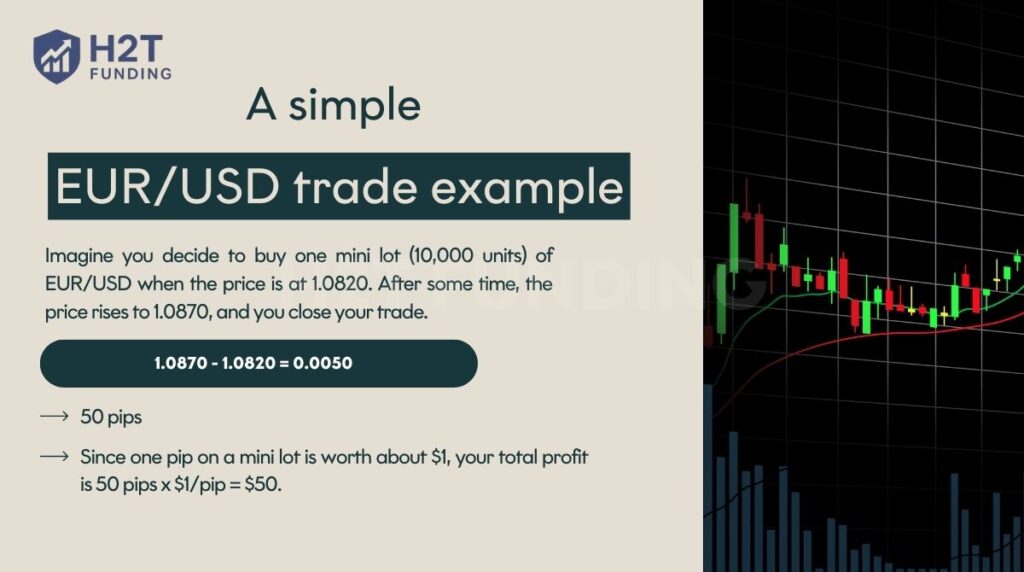
Imagine you decide to buy one mini lot (10,000 units) of EUR/USD when the price is at 1.0820. After some time, the price rises to 1.0870, and you close your trade.
- Pip Movement Calculation: 1.0870 – 1.0820 = 0.0050.
- Total Pips Gained: This 0.0050 change equals 50 pips.
- Monetary Result: Since one pip on a mini lot is worth about $1, your total profit is 50 pips x $1/pip = $50.
This example shows how a small price change can result in a tangible financial outcome.
3.2. How pips define your risk management
Beyond calculating results, pips are the language of risk management, especially during periods of high market volatility. Instead of thinking in abstract dollar amounts, traders use pips to set their strategic exit points. This approach keeps risk consistent across different trades.
For example, a trader might decide:
- I will set my stop-loss at 30 pips below my entry.
- My take-profit target is 60 pips above my entry.
This method establishes a clear Risk: Reward ratio (in this case, 1:2). It removes emotion from the decision-making process and helps manage the inevitable portfolio dips, which connects to understanding what a drawdown in trading is. Mastering this discipline is a core principle for traders aiming to get funded.
4. Pip calculator: Estimate your pip value instantly
While understanding the formula behind pip calculations is important, most traders prefer a fast, practical way to estimate pip value before entering a trade. Below is a simple pseudo-calculator you can use instantly, no tools or software required.
4.1. Quick Pip value calculator (USD Account)
Step 1: Choose your lot size
Step 2: Match it to the pip value below
| Lot Size | Units Traded | Pip Value (USD) |
|---|---|---|
| Standard (1.0) | 100,000 | ≈ $10 per pip |
| Mini (0.1) | 10,000 | ≈ $1 per pip |
| Micro (0.01) | 1,000 | ≈ $0.10 per pip |
This applies to most USD-quoted pairs such as EUR/USD, GBP/USD, and AUD/USD.
4.2. Example: Estimate profit or loss in seconds
Let’s say you trade 0.2 lots (two mini lots) on EUR/USD.
- Pip value: $2 per pip
- Market moves: 35 pips
Estimated result: 35 pips × $2 = $70 profit or loss
No complex math, just multiply pips by pip value.
4.3. For non-USD pairs or JPY pairs
- JPY pairs (e.g., USD/JPY): A pip is 0.01 instead of 0.0001, but the platform usually auto-converts the value to your account currency.
- Non-USD quote currency (e.g., EUR/GBP): Pip value is calculated in the quote currency first, then converted to your account currency automatically by most platforms.
Even when platforms handle the conversion, knowing this structure helps you validate risk before placing a trade.
5. Are pips different for gold (XAUUSD) or crypto?
While the concept is similar, the way price movements are measured for assets like Gold and cryptocurrencies differs slightly from forex pips. This distinction is important for traders who diversify their portfolios beyond standard currencies.
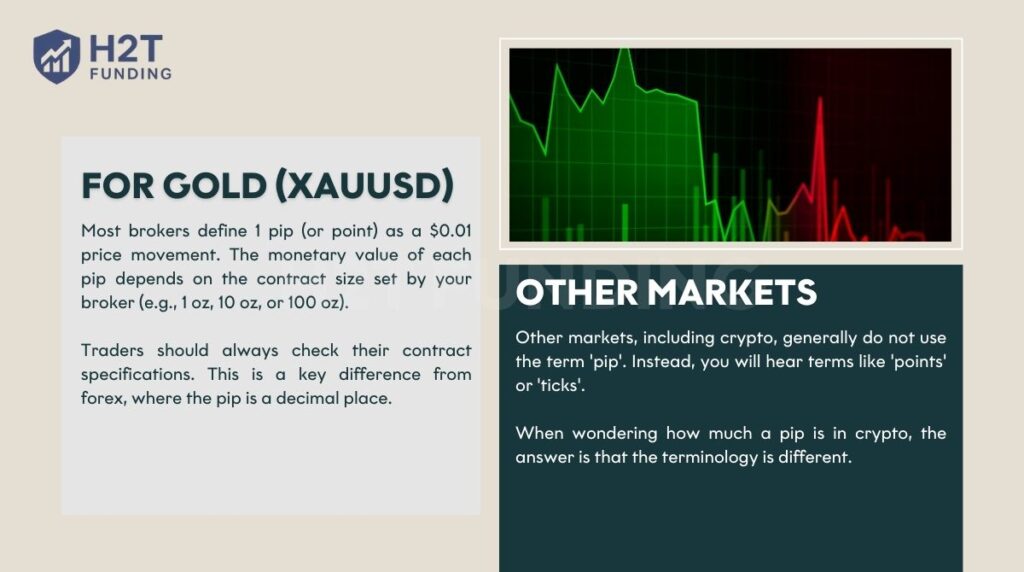
For Gold (XAUUSD), most brokers define 1 pip (or point) as a $0.01 price movement. The monetary value of each pip depends on the contract size set by your broker (e.g., 1 oz, 10 oz, or 100 oz). Traders should always check their contract specifications. This is a key difference from forex, where the pip is a decimal place.
For example, if the price of gold moves from $1950.50 to $1950.80, this is a 30-pip movement. How much a pip in gold is worth in monetary terms depends on your contract size, not just the pip itself.
Other markets, including crypto, generally do not use the term ‘pip’. Instead, you will hear terms like ‘points’ or ‘ticks’. When wondering how much a pip is in crypto, the answer is that the terminology is different.
For an asset like Bitcoin (BTC), a price change from $60,000 to $60,001 is a one-dollar move, or one ‘point’. The principle remains the same: measuring the smallest unit of price change. However, the specific name and value of that unit are unique to each asset class.
6. Who this Pip guide is (and is not) for?
This guide is designed to give a clear, practical understanding of forex pips and how they translate into real profit and loss. However, it is important to clarify who this content is meant for and who it is not.
- Beginner and intermediate forex traders who want to understand price movement in simple, standardized terms
- Traders learning risk management, position sizing, and stop-loss placement
- Anyone asking practical questions like “How much is 1 pip worth?” or “How many dollars is a 50-pip move?”
The explanations focus on clarity, real examples, and common trading scenarios rather than mathematical complexity.
6.1. This guide is NOT for advanced quantitative or institutional traders
If you are already working with:
- Algorithmic models
- Tick-level pricing data
- Custom volatility-adjusted position sizing
Then pip-based explanations may feel overly basic. Advanced traders typically operate directly in points, ticks, or monetary risk, rather than relying on pip conventions.
6.2. This guide is NOT about choosing brokers or trading platforms
This article explains what a pip is and how its value is calculated, not:
- Which broker has the lowest spreads
- Which platform executes trades faster
- Which prop firm or broker to use
Broker-specific costs like commissions, slippage, and execution speed are outside the scope of this guide.
6.3. This guide is NOT a trading strategy
Understanding pips helps you measure outcomes, but it does not tell you:
- When to enter or exit trades
- Which indicators to use
- How to predict market direction
Pips are a measurement tool, not a strategy by themselves. Profitable trading still depends on a tested system, discipline, and risk control.
7. FAQs about pips
The dollar value of one pip depends entirely on your trade size. For currency pairs where the USD is the quote currency, a standard lot makes one pip worth about $10. This scales down to $1 for a mini lot and just $0.10 for a micro lot.
A single pip is worth $10 only under very specific conditions. You must be trading a standard lot (100,000 units) on a pair like EUR/USD, and your account must be denominated in US dollars. For any other trade size or pair, the value will be different.
The value of 50 pips scales with your position size. On a standard lot, it would be approximately $500. This amount becomes $50 if you trade a mini lot and just $5 for a micro lot.
No, a pip is significantly smaller than one cent. For most currency pairs, a pip is just $0.0001, which is one-hundredth of a single US cent. This concept is sometimes confused with basis points, which are typically used to measure interest rate changes.
For Gold (XAUUSD), a pip is calculated as a $0.01 price movement. The total monetary value then depends on the contract size (in ounces). For a standard 100-ounce contract, each pip of movement is equal to $1 in profit or loss.
A pipette is a fractional pip, representing one-tenth of a standard pip’s value. It appears as an extra decimal place, offering more granular pricing, but most traders focus on the full pip for their analysis and calculations.
The spread is your basic cost of trading, defined as the difference between the buy (ask) and sell (bid) prices. This bid-ask spread is measured in pips. A smaller spread means a lower transaction cost for the trader.
Yes, the monetary value of a pip changes constantly for different pairs. While the unit (e.g., 0.0001) is fixed, its worth in your account’s currency will fluctuate based on the pair’s current exchange rate.
There is no magic number of pips to target. Your goal depends entirely on your strategy. A scalper might aim for 5-10 pips, whereas a swing trader could target over 100. The most important metric is maintaining a positive risk-to-reward ratio.
While not strictly necessary, understanding the calculation is empowering. Most modern trading platforms calculate potential profit and loss for you automatically. However, knowing how it works helps you plan trades and manage risk even when offline.
8. Conclusion
Ultimately, knowing how much a pip is the foundation of disciplined trading. It’s the core metric for transforming abstract market movements into concrete numbers, especially when navigating markets shaped by economic uncertainty. This allows you to calculate potential profit, define your risk, and measure success objectively, which is the first essential step on your trading journey.
But a pip is just a number until it’s part of a plan. To apply this knowledge effectively, explore the Prop Firm & Trading Strategies category at H2T Funding. There, you will find proven methods for using pips in risk management, passing funding challenges, and building a sustainable trading career.