

Every prop trader’s journey eventually leads to a critical crossroads that sparks the FundedNext vs FTMO, which is a better debate. This isn’t just a choice between two firms; it’s a decision between two distinct trading philosophies. Do you align with FTMO’s legacy of disciplined, structured trading, or do you thrive in FundedNext’s ecosystem of flexibility, speed, and aggressive growth?
As a trader who once failed an FTMO challenge over a minor news rule but later succeeded with FundedNext’s flexible model, I understand that small rule differences have a huge impact. This debate isn’t just about numbers; it’s about finding a partner that fits your trading psychology
You need a deep-dive analysis from experts who understand the nuances that matter. That’s exactly what the team at H2T Funding has prepared. Dive into our comprehensive breakdown below to see which firm truly aligns with your path to profitability.
Key Takeaways
- FundedNext prioritizes flexibility and speed, offering multiple funding models and rapid scaling. FTMO stands for discipline and reliability, providing a standardized, industry-proven evaluation process.
- FundedNext is often better for traders who value diverse strategies, want to trade news, and seek aggressive capital growth. FTMO excels for systematic traders who thrive within a structured framework and prioritize a firm’s long-standing reputation.
- FundedNext offers a wider variety of challenges (1-Step, 2-Step) with generally more relaxed rules. FTMO’s 2-Step Evaluation is stricter, especially regarding news trading on funded accounts, demanding a highly disciplined approach.
- FundedNext typically presents a lower entry cost for comparable account sizes. Both firms offer a 100% fee refund but differ in payout frequency, with FundedNext offering bi-weekly payouts from the start on some models.
- FundedNext offers an impressive scaling program. Traders can grow their account by 40% every four months, up to a $4 million maximum. This offers a potentially faster path to large-scale funding.
- As an industry pioneer, FTMO boasts nearly a decade of proven reliability. FundedNext has rapidly built immense trust through its transparent policies, fast payouts, and strong community backing on platforms like Reddit and Trustpilot.
1. Overview of FundedNext and FTMO
FundedNext and FTMO represent two titans of prop trading, both focused on trader development but catering to different archetypes. This FundedNext vs FTMO review reveals FundedNext as an agile innovator with diverse models, competitive pricing, and strong community engagement. It is built for traders who demand flexibility and rapid growth.
In contrast, FTMO stands as the industry’s pioneering force, built on a foundation of discipline and trust since 2015. With a standardized evaluation process, stricter rules, and an unparalleled reputation for reliable payouts, it appeals to traders who value structure and a proven track record.
Criteria Table – Overview
| Criteria | FundedNext | FTMO |
|---|---|---|
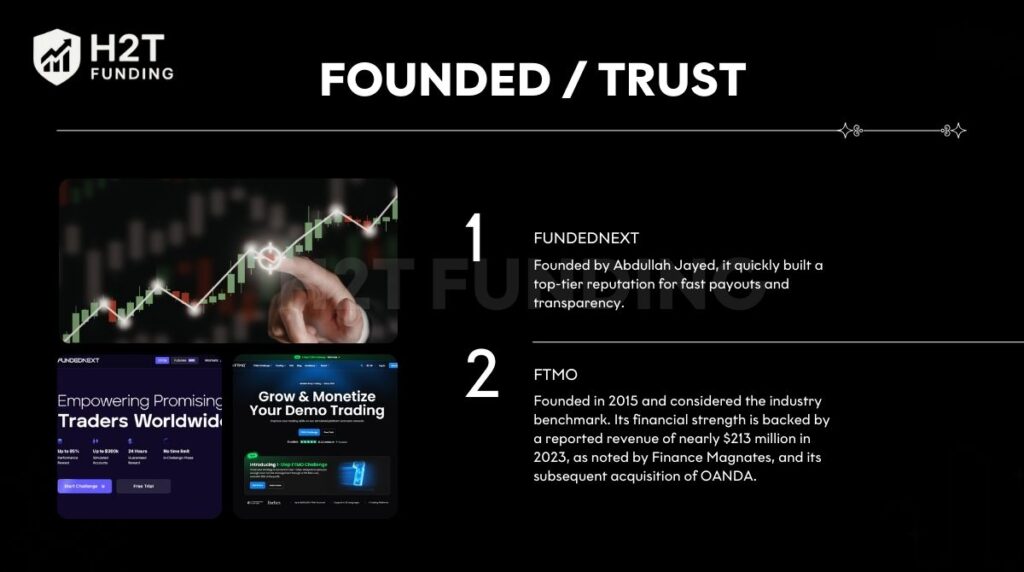
| Founded / Trust | Founded by Abdullah Jayed, it quickly built a top-tier reputation for fast payouts and transparency. | Founded in 2015 and considered the industry benchmark. Its financial strength is backed by a reported revenue of nearly $213 million in 2023, as noted by Finance Magnates, and its subsequent acquisition of OANDA. |
| Evaluation Models | Highly diverse: Stellar 1-Step, Stellar 2-Step, Stellar Lite, Instant, and two Futures models. | Standardized 2-Step FTMO Challenge with a Swing account option for more flexibility. |
| Account Sizes | From $5,000 up to $300,000 simulated capital. | From $10,000 up to $200,000 simulated capital (can be merged up to $400,000). |
| Asset Classes | Forex, Indices, Commodities, and Cryptocurrencies. | Forex, Indices, Commodities, and Cryptocurrencies. |
| Trading Platforms | Diverse platforms, including cTrader, Match-Trader, and Futures platforms. Still accepts US traders via compliant platforms. | Transitioned to DXtrade and proprietary platforms. Re-entered the US market via an OANDA partnership (Aug 2025), no longer offering MT4/5 to US clients. |
| Profit Split | Up to 90%. Select models offer a 15% profit share from the challenge phase (conditions apply). | Up to 90% of simulated profits. |
| Minimum Days | Varies by model, typically 5 minimum trading days for Stellar challenges. No minimum for others. | 4 minimum trading days for both the Challenge and Verification phases. |
| Scaling Programs | 40% capital increase every four months, up to a maximum of $4 million. | 25% capital increase every four months, up to a maximum of $2 million. |
| Payouts | Processed within 24 hours (Brand Promise). Bi-weekly payouts available. | Reliable and processed on a bi-weekly basis by default. |
| Risk Restrictions | Generally, more flexible rules on news trading and overnight holding. | Stricter rules, especially on news trading and weekend holding for standard FTMO Accounts. |
Decidingbetween FundedNext or FTMO, which is better, ultimately depends on your priorities. If you value a variety of choices, faster growth potential, and fewer restrictions, FundedNext is a powerful contender. If you prefer a proven, structured path from a firm with the longest industry reputation, FTMO remains a top choice.
Disclaimer: Rules, pricing, and trading conditions may change over time. Traders should always verify the latest terms directly on the official FundedNext or FTMO websites before purchasing any challenge.
FundedNext
#1
Account Types
1-step, 2-step, and Instant Funding
Trading Platforms
MT4, MT5, cTrader, Match Trader
Profit Target
4% – 10%
Our take on FundedNext
FundedNext has rapidly emerged as a dominant force in prop trading by focusing on trader-centric benefits and unmatched flexibility. This firm is an excellent fit for traders who want multiple pathways to funding and an environment that supports various strategies, including news trading and automated systems.
| 💳 Challenge Fee | $32 – $1,099 |
| 👥 Account Types | 1-step, 2-step, and Instant Funding |
| 💰 Profit Split | 80% – 95% |
| 💵 Account Size | $2K – $200K |
| ⏱️ Time Limit | No time limit |
| 🎯 Profit Target | 4% – 10% |
| 📊 Trading Platforms | MT4, MT5, cTrader, Match Trader |
| 🛍️ Asset Types | Forex, Indices, Commodities, Crypto, CFDs |
FTMO
#2

Account Types
2-step
Trading Platforms
MT4, MT5, cTrader, DXTrade
Profit Target
5% – 10%
Our take on FTMO
FTMO is the original pioneer of the modern prop trading industry, setting the standard for what a reliable firm should be. Its reputation is built on consistency, discipline, and a clear, structured path to becoming a funded trader. This makes it a top choice for serious traders who value stability and a proven system.
| 💳 Challenge Fee | €89 – €1,080 |
| 👥 Account Types | 2-step |
| 💰 Profit Split | 80% – 90% |
| 💵 Account Size | $10K – $200K |
| ⏱️ Time Limit | No time limit |
| 🎯 Profit Target | 5% – 10% |
| 📊 Trading Platforms | MT4, MT5, cTrader, DXTrade |
| 🛍️ Asset Types | Forex, Commodities, Indices, Stocks, Crypto |
Read more:
2. FundedNext vs FTMO comparison: Core models and key rules
The true character of a prop firm is revealed in its rules. This FundedNext vs FTMO comparison moves beyond marketing to analyze the specific models and regulations that will govern your trading. How a firm structures its evaluation, manages risk, and dictates strategy can either empower you or hold you back.
2.1. Funding model & evaluation difficulty
The path to a funded account differs significantly between the two firms. FundedNext offers a buffet of options designed for various trader preferences, including one-phase challenges that shorten the evaluation time. FTMO provides a single, highly refined two-step process that has become the industry’s benchmark for testing trader discipline.
Deciding which is better, FTMO vs FundedNext, in this regard, depends on whether you prioritize speed and flexibility or a standardized, universally respected gauntlet.
| Criteria | FundedNext (Stellar 2-Step) | FTMO (Standard Challenge) |
|---|---|---|
| Evaluation Required | Yes, a 2-phase process (1-phase options are available in other models). | Yes, a mandatory 2-phase process (Challenge and Verification). |
| Profit Target | Phase 1: 8%Phase 2: 5% | Phase 1: 10%Phase 2: 5% |
| Time Pressure | None. The trading period is unlimited for all challenges. | None. The trading period is unlimited, removing a major source of stress. |
| Psychological Stress | Lower due to the reduced Phase 1 profit target and multiple account options. | Higher due to the 10% target in Phase 1, which demands strong performance from the start. |
| Overall Difficulty | Generally considered more accessible due to the lower initial profit target. | Considered the industry standard for difficulty, requiring consistent and disciplined trading. |
Beyond the numbers, the psychological pressure of each evaluation differs. FTMO’s 10% target, while achievable, can create significant mental stress for traders who experience an early drawdown, forcing them to chase profits. For traders with limited capital to retry challenges, this pressure can be a deal-breaker.
In contrast, FundedNext’s lower 8% target provides more breathing room, reducing the psychological burden and allowing traders to focus more on strategy execution rather than just hitting a high benchmark.
In conclusion, FundedNext is objectively easier to pass for its core 2-step model due to the lower 8% profit target in the first phase. However, FTMO’s more demanding 10% target is designed to filter for highly consistent traders. This requires more sustainable skills, and many traders seek guidance on how to pass the FTMO challenge to succeed.
2.2. Drawdown, consistency & risk rules
Risk management rules are the bedrock of any prop firm. Both FundedNext and FTMO use similar drawdown limits for their main offerings, but subtle differences in other rules can have a major impact on your trading approach.
| Criteria | FundedNext (Stellar Models) | FTMO |
|---|---|---|
| Max Drawdown | 10% fixed, based on the initial account balance. | 10% fixed, based on the initial account balance. |
| Daily Loss Limit | 5% fixed, based on the initial account balance. | 5% fixed, based on the initial account balance. |
| Trailing Drawdown | No trailing drawdown on Stellar CFD models. Note: It applies to Futures models. | No trailing drawdown, providing a stable loss limit. |
| Consistency Rules | Most Stellar models have no explicit consistency rule, but some accounts may have underlying conditions to manage risk. | No explicit consistency rule, but trades are reviewed for responsible risk behavior. |
| Rule Strictness | Moderate. Rules are clear, but the firm is known for its trader-friendly approach. | High. Rules are strictly enforced, reflecting the firm’s emphasis on discipline. |
In summary, for their primary CFD challenges, both firms offer straightforward and trader-friendly risk rules with fixed drawdowns. Neither imposes restrictive consistency rules, giving traders the freedom to trade dynamically without fear of being penalized for a single successful day.
2.3. News, overnight & strategy policies
A trader’s strategy is only as good as the rules allow. Here, FundedNext and FTMO show their most significant philosophical differences. FundedNext offers nearly complete freedom, while FTMO requires traders to demonstrate skill in navigating around major market events.
These policy differences are critical, as high volatility during news can dramatically impact FundedNext vs FTMO spreads, affecting execution quality regardless of the rules.
| Policy | FundedNext | FTMO |
|---|---|---|
| News Trading | Allowed. Traders can trade during all high-impact news events on all account types. | Restricted on standard FTMO Accounts (not allowed 2 mins before/after major news). Allowed on Swing accounts. |
| Overnight Trading | Allowed. Traders can hold positions overnight without any restrictions. | Allowed. Holding trades overnight is permitted. |
| Weekend Trading | Allowed. Holding positions over the weekend is permitted on all active models. | Restricted to standard FTMO Accounts. Fully allowed on FTMO Swing accounts. |
| EA / Automation | Allowed. Expert Advisors and bots are permitted, provided they follow fair use policies (e.g., no HFT). | Allowed. EAs and algorithmic trading are permitted, but strategies must be unique and not exploit the platform. |
| Allowed Strategies | Most strategies are allowed, including scalping. Prohibits abusive practices like tick scalping or arbitrage. | Most legitimate strategies are permitted. Prohibits exploitative practices that don’t reflect real market trading. |
Ultimately, FundedNext provides a far more flexible environment for discretionary news traders and swing traders who need to hold positions over the weekend. FTMO’s standard account is better suited for systematic traders whose strategies naturally avoid high-impact news or weekend holding.
3. FundedNext vs FTMO review: Fees, refunds, and cost efficiency
The initial fee is a trader’s first investment, making cost efficiency a critical factor in any prop firm decision. While both firms offer a full refund, the upfront cost and payout structure directly impact your financial runway. This FTMO vs FundedNext price comparison breaks down exactly what you pay and when you get it back.
| Criteria | FundedNext | FTMO |
|---|---|---|
| Fee Type | One-time fee for each challenge attempt. | One-time fee for each challenge attempt. |
| Refund Policy | 100% fee refund with the first payout on most models (third payout for Stellar Lite). | 100% fee refund with the first payout from the FTMO Account. |
| Challenge Cost | Highly competitive. For a 549. | Standard pricing. For a $100k account, the FTMO Challenge costs €540 (approx. $580). |
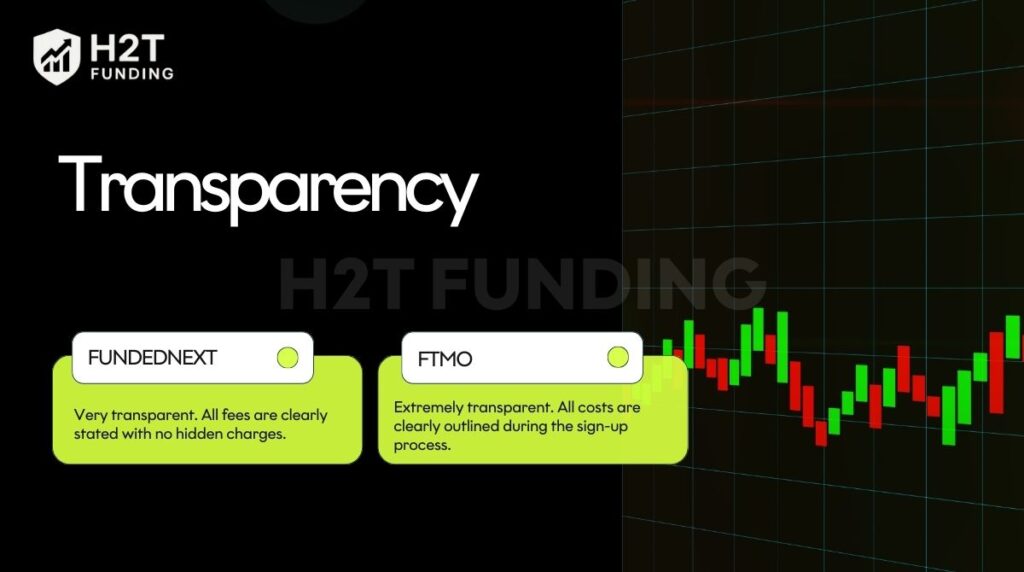
| Transparency | Very transparent. All fees are clearly stated with no hidden charges. | Extremely transparent. All costs are clearly outlined during the sign-up process. |
| Added Fees | None. There are no monthly fees or recurring charges for the funded account. | None. The initial fee is the only cost required to become an FTMO Trader. |
| Payout Cycle | Flexible. Offers bi-weekly payouts and a Brand Promise to process requests, often within 24 hours in most cases. | Reliable. Payouts are processed on a bi-weekly basis by default. |
In short, FundedNext offers a more cost-effective entry point for traders, with lower upfront fees for its most popular challenge models. Both firms provide excellent value by refunding the entire fee upon reaching the first profit split, effectively making the evaluation free for successful traders. This makes the initial decision less about long-term cost and more about the immediate financial commitment.
4. FundedNext vs FTMO debate: Profit split and scaling potential
Beyond passing the challenge, a prop firm’s real value lies in its profit-sharing and growth opportunities. The FundedNext vs FTMO debate heats up here, as both firms offer lucrative splits but follow different philosophies for scaling capital. One prioritizes rapid, aggressive growth, while the other offers a steady, time-tested path.
Deciding which is better, FTMO vs FundedNext, depends on your long-term financial goals and how quickly you want to reach them.
| Criteria | FundedNext | FTMO |
|---|---|---|
| Profit Split | Starts at 80% and can increase to 90%. Also offers a 15% profit share from the challenge phase. | Starts at 80% and increases to 90% through the Scaling Plan. |
| Account Scaling | Highly aggressive: 40% capital increase every four months if conditions are met, up to $4 million. | Structured and steady: 25% capital increase every four months if criteria are met, up to $2 million. |
| Payout Frequency | Flexible. Bi-weekly payouts are available from the beginning on most models. | Standard. Payouts can be processed every 14 days. |
| Minimum Payout | No specified minimum amount; traders can request withdrawals of their earned profits. | No officially stated minimum; payouts follow the 14-day cycle. |
| Withdrawal Conditions | Traders must be profitable and have met the trading cycle requirements to request a payout. | Traders must be profitable and can request a payout 14 days after their first trade on the FTMO Account. |
In conclusion, FundedNext offers a more aggressive and potentially faster path to high-level capital. Its 40% scaling increment and $4 million cap are among the best in the industry. FTMO provides a very reliable and attractive scaling plan, but its 25% increments and $2 million ceiling are more conservative. For traders aiming for the highest possible funding in the shortest time, FundedNext holds a clear edge.
5. FTMO vs FundedNext: Platforms and tradable markets
A trader’s success depends heavily on their tools and market access. The comparison of FTMO vs FundedNext reveals that both firms provide access to top-tier platforms and a wide range of assets. However, FundedNext distinguishes itself by offering specialized platforms for Futures trading, catering to a broader audience.
While both firms aim for tight, competitive conditions, factors like commissions and execution speed can vary, impacting the final FTMO vs FundedNext spread you experience.
| Criteria | FundedNext | FTMO |
|---|---|---|
| Trading Platforms | Extensive selection: MT4, MT5, cTrader, Match-Trader. Crucially, it also offers Tradovate and NinjaTrader for Futures. | Solid selection: MT4, MT5, cTrader, and the web-based DXtrade platform. |
| Asset Classes | Wide range of CFDs (Forex, Indices, Commodities, Crypto) and Futures. Excellent market coverage across asset types. | Comprehensive CFDs including Forex, Indices, Commodities, and Cryptocurrencies. |
| Execution Speed | Simulates real-market conditions with potential minor delays to mirror live trading environments. | Simulates real-market conditions. Acknowledges that delays up to 200ms can occur to replicate a live environment. |
| Commissions & Fees | Offers highly competitive commissions, helping to maximize trader profitability. | Charges simulated commissions to accurately reflect real market trading costs. |
| Trader Dashboard | A modern and comprehensive dashboard for tracking metrics, requesting payouts, and managing accounts. | Account MetriX is a highly-regarded and detailed dashboard for performance analysis and account management. |
In conclusion, FundedNext offers a superior range of platforms by including dedicated options for Futures traders, making it the clear choice for those who trade in that market. For CFD traders, both firms provide excellent access to popular platforms and a similar range of assets, with FundedNext often having an edge on lower commission structures.
6. Payout & trust: FundedNext vs FTMO Reddit and Trustpilot reviews
A prop firm’s promises mean nothing without a proven track record of paying its traders. To gauge real-world reliability, we analyzed hundreds of reviews from Trustpilot and unfiltered discussions on Reddit communities like r/Forex and r/Daytrading. This is where the truth about payout speed, prop firm rules, and customer support comes to light.
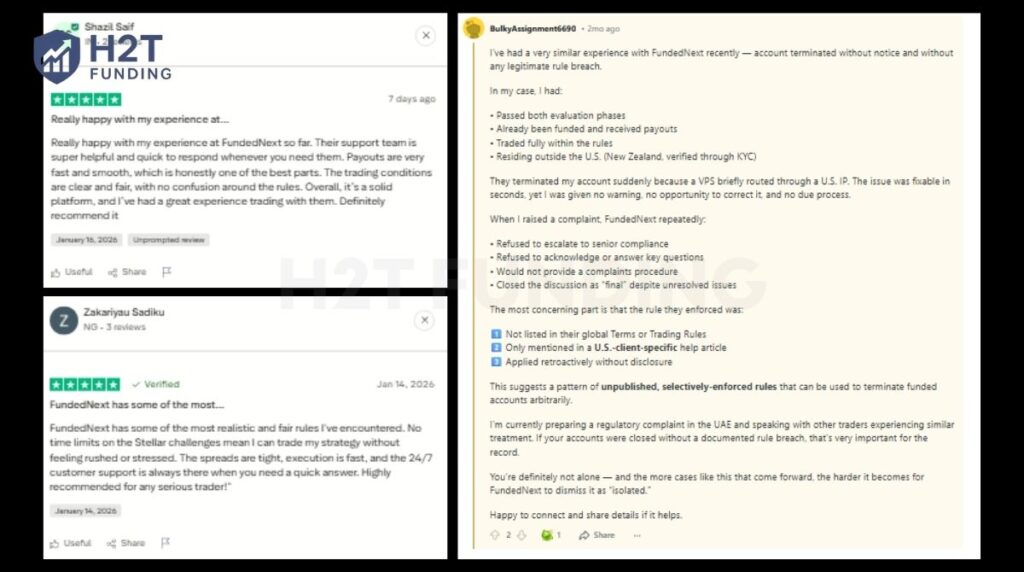
The consensus paints a clear picture. While both firms are seen as legitimate, unfiltered discussions on the FTMO vs FundedNext Reddit threads highlight different strengths. FTMO is praised for its long-standing consistency, while FundedNext earns accolades for its rapid payout speeds and modern, flexible approach.
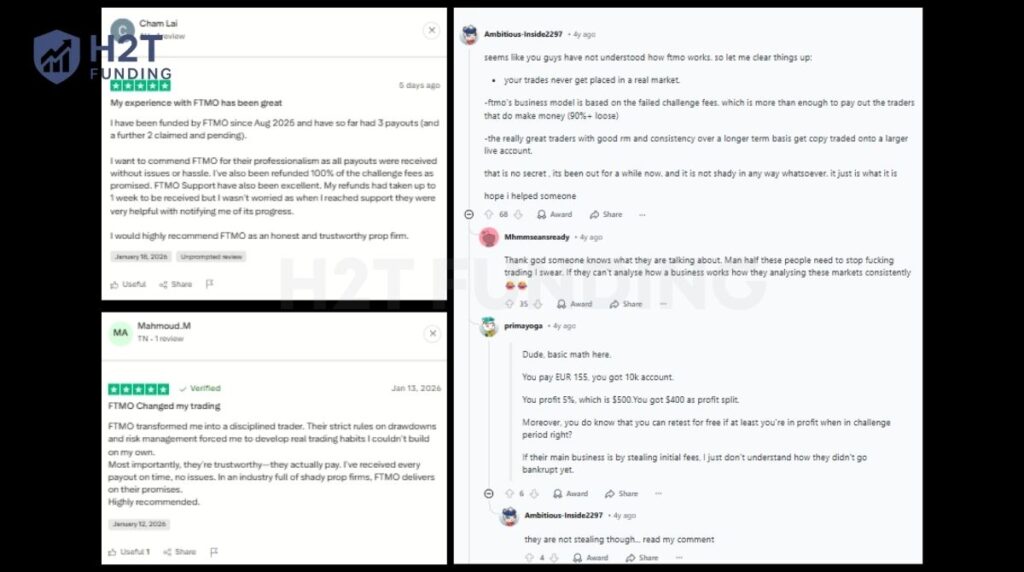
Community Sentiment Summary
After analyzing feedback from thousands of traders, a clear narrative emerges. Both FundedNext and FTMO are overwhelmingly regarded as legitimate firms that pay their successful traders.
Discussions on Reddit and Trustpilot confirm that FTMO’s nearly decade-long reputation is well-earned, with countless traders vouching for its consistent, professional, and reliable payout process. Negative feedback rarely questions if FTMO pays, but rather centers on the strictness of its rules, which some traders feel are designed to be difficult.
FundedNext, while newer, has rapidly built an equally strong reputation for trust. Its “Brand Promise” of 24-hour payouts is frequently confirmed in reviews, with many traders reporting they receive their funds in just a few hours.
Criticisms of FundedNext are less about its core rules and more often related to technical issues or misunderstandings of its more complex, varied account types. Ultimately, the community agrees: if you follow the rules, both firms will pay.
7. FundedNext vs FTMO: Which prop firm is easier to pass?
For most traders, this is the ultimate question. Passing the evaluation is the gateway to funding, and the difficulty of that gateway is a primary concern. While both firms have removed time limits, eliminating a major source of pressure, key differences in profit targets and rule complexity make one firm objectively more accessible.
This section directly answers the question of which is better, FTMO vs FundedNext, when it comes to passing the challenge.
| Criteria | Winner | Notes |
|---|---|---|
| Profit Target | FundedNext | With an 8% profit target in Phase 1 of its Stellar 2-Step challenge, FundedNext requires 20% less profit than FTMO’s 10% target. This is a significant mathematical advantage. |
| Drawdown Strictness | Both | Both firms use a 5% daily and 10% maximum fixed drawdown based on the initial balance for their main challenges. Neither uses a trailing drawdown, making risk parameters identical and easy to manage. |
| Rule Complexity | FundedNext | FundedNext allows news trading and weekend holding by default. FTMO’s restrictions on these activities add a layer of complexity that traders must constantly monitor, increasing the risk of an accidental breach. |
| Overall Difficulty | FundedNext | The combination of a lower initial profit target and more flexible trading rules (especially regarding news) makes FundedNext’s evaluation process statistically easier to pass for the average trader. |
An analysis of the rules suggests FundedNext’s requirements may be more approachable for some traders. The combination of a lower initial profit target and more flexible rules (especially regarding news) removes two of the biggest hurdles traders face during evaluations.
8. FundedNext and FTMO: Which prop firm suits your trading style?
The best prop firm is not a one-size-fits-all solution. Your strategy, risk tolerance, and long-term goals will determine which firm’s ecosystem is the right fit. This guide breaks down which firm is better suited for specific trader archetypes.
| Trader Type | Best Choice | Why |
|---|---|---|
| Beginners | FundedNext | The lower profit target (8% vs 10%) and more relaxed rules on news trading create a more forgiving environment for traders still honing their skills, making it one of the best prop firms for beginners. The variety of models also allows them to find a perfect fit. |
| Systematic Traders | FTMO | FTMO’s highly structured, standardized evaluation process and strict rules align perfectly with traders who follow a disciplined, rule-based system that often avoids high-volatility events. |
| Swing Traders | FundedNext | FundedNext allows unrestricted overnight and weekend holding on all its main accounts. This makes it the clear winner for traders who hold positions for several days or weeks to capture larger market moves. |
| Scalpers | Both | Both firms allow scalping but prohibit exploitative, high-frequency strategies like tick scalping. Success will depend more on execution and spreads rather than a specific rule advantage at either firm. |
| Risk-Averse Traders | FTMO | FTMO’s long-standing reputation since 2015 provides an unparalleled sense of security. Its strict rules also encourage a more disciplined and risk-managed approach to trading. |
| Traders Aiming for $1M+ Capital | FundedNext | FundedNext’s scaling plan offers a 40% capital increase every four months, up to a massive $4 million cap. This provides a significantly faster and higher ceiling for growth compared to FTMO’s $2 million limit. |
In short, your choice should reflect your priorities. Traders seeking flexibility, speed, and the highest growth potential may find FundedNext more suitable. In contrast, those who prioritize a structured environment and the security of a long-standing reputation may lean toward FTMO.
9. FAQs
There is no single “best” firm; it depends on your trading style. FundedNext is often better for traders seeking flexibility, lower costs, and aggressive scaling. FTMO is superior for traders who value a structured, disciplined environment and a long-standing reputation.
FundedNext is generally better for beginners. Its Stellar 2-Step challenge has a lower 8% profit target in Phase 1 (compared to FTMO’s 10%) and more relaxed rules around news trading, creating a more forgiving evaluation process.
Not necessarily. FTMO is better in terms of its long-standing reputation and highly structured system, which appeals to disciplined traders. However, FundedNext is better in areas like pricing, scaling potential ($4M cap vs. FTMO’s $2M), and rule flexibility, making it a stronger choice for many modern traders.
FundedNext is easier to pass. Its lower 8% profit target in the first evaluation stage and permission to trade during news events give it a distinct advantage over FTMO’s more demanding requirements.
Both firms offer a profit split of up to 90%. However, FundedNext’s scaling plan is more aggressive, offering a 40% account increase every four months up to a $4 million maximum. FTMO offers a 25% increase up to a $2 million maximum.
The main differences are the profit targets and rules. FundedNext’s Stellar 2-Step challenge requires an 8% profit in Phase 1, while FTMO requires 10%. Additionally, FTMO restricts news trading on its standard funded accounts, whereas FundedNext does not.
Yes. According to TradeInformer and Finance Magnates, FTMO temporarily suspended U.S. access in January 2024. The firm officially returned to the U.S. market in August 2025 through a strategic partnership with OANDA. However, US traders cannot use the MT4/MT5 platforms.
Yes. FundedNext accepts U.S. clients for both its CFD and Futures challenges and provides compliant trading platforms like Match-Trader, cTrader, Tradovate, and NinjaTrader.
The primary factor is compliance and platform availability. Both firms accept US traders, but through different channels. FTMO operates via its OANDA partnership without MT4/5 access. FundedNext provides alternative platforms like cTrader, Match-Trader, and its Futures offerings.
Yes. FundedNext has an excellent reputation for fast and reliable payouts. They back this with a “Brand Promise” to process withdrawal requests within 24 hours. Community reviews on Trustpilot and Reddit overwhelmingly confirm that they pay their traders.
Yes. While you trade on a demo account, FTMO pays real money rewards based on your simulated profits. They have a nearly decade-long, proven track record of consistently paying successful traders, with hundreds of millions of dollars paid out globally.
Yes, FundedNext is a legitimate and highly-rated proprietary trading firm. It has a strong reputation for transparency, fair rules, and reliable payouts, backed by thousands of positive reviews on Trustpilot.
Yes, FTMO is one of the most legitimate and respected proprietary trading firms in the world. Founded in 2015, it is considered a pioneer in the industry and has a long-standing, proven history of paying traders.
The primary cons include being a newer firm without FTMO’s decade-long history, and the variety of account models can be confusing for some traders. Some Reddit users have also reported issues with sudden account closures related to complex rules like IP address usage.
The main disadvantages are its stricter rules (especially on news trading and weekend holding), a higher entry fee for challenges compared to FundedNext, and a less aggressive scaling plan.
This is not a default rule. FundedNext may implement the 1% Risk Limit Rule as a measure on accounts detected with “Gambling Behavior” to enforce better risk management.
The fee for a 15k Stellar 2-Step account at FundedNext is $119. This fee is refundable with the first profit split.
The cost depends on the account size. For example, a $10,000 FTMO Challenge costs €155 (approximately $164), and a $100,000 challenge costs €540 (approximately $580).
The provided information does not explicitly state what FTMO stands for. It originated from a Czech company named Získejúčet.cz and was rebranded to FTMO as it expanded globally.
“Better” is subjective. Firms like FundedNext are often considered better in terms of flexibility, pricing, and scaling potential. However, few firms can match FTMO’s long-standing reputation for reliability and its structured, disciplined approach.
Both firms aim to provide competitive, raw spreads. However, FundedNext is often cited as having lower commissions, which contributes to a lower overall trading cost per transaction compared to FTMO.
FundedNext is cheaper. For a $100k account, FundedNext’s Stellar 2-Step challenge costs $549, while FTMO’s equivalent challenge costs €540 (around $580), making FundedNext the more cost-effective option.
Both firms provide excellent support tools. FTMO offers an economic calendar and detailed analytics, while FundedNext provides similar tools plus an AI assistant. Both firms offer multiple reliable withdrawal methods, including crypto (USDT) and bank transfers, ensuring traders can access their profits securely. Many traders use a trading journal to track performance on both platforms.
10. Conclusion
The final verdict in the FundedNext vs FTMO debate comes down to your personal trading identity. Your choice should reflect your core priorities as a trader.
FundedNext is the clear winner for traders who demand flexibility, rapid scaling potential, and lower entry costs. In contrast, FTMO remains the superior choice for disciplined traders who value a structured environment and the unmatched security of a decade-long industry reputation.
So, which is better, FundedNext or FTMO?
- Choose FundedNext if you are a dynamic trader who leverages news and wants the fastest path to a multi-million dollar account. Its rules are built for flexibility.
- Choose FTMO if you are a disciplined, systematic trader who values structure above all else. Its rules will reward consistency but will quickly penalize impulsiveness.
To see how these prop firms stack up against other industry leaders, explore more head-to-head analyses in the Compare category on the H2T Funding blog.