

Choosing between raw spreads vs no commission can materially change your trading costs. With raw‑spread accounts, you see near‑market bid/ask and pay a per‑lot commission; with no‑commission accounts, fees are bundled into a wider spread.
This guide shows how each model impacts total cost, execution quality, and risk control so you can match the account type to your strategy. Compare costs now with H2T Funding and choose the pricing model that keeps more profit in your pocket.
Key takeaways:
- Raw spread accounts show near-market bid and ask prices and add a commission per lot, while no-commission accounts widen the spread and remove the separate commission line.
- If your trading volume is high or you scalp, the smaller spread often outweighs the commission. If you place fewer trades, a wider but bundled spread can be easier to live with.
- Raw pricing offers clearer cost transparency; no commission offers more predictable costs at a glance.
- Tight pricing is only useful if execution speed and slippage are under control. That is where your broker and your platform setup really show.
- Consider leverage, margin, and pip value when comparing models. High leverage magnifies both profit and cost, so focus on overall cost control, not just the cheapest setup.
1. What is raw spread vs no commission?
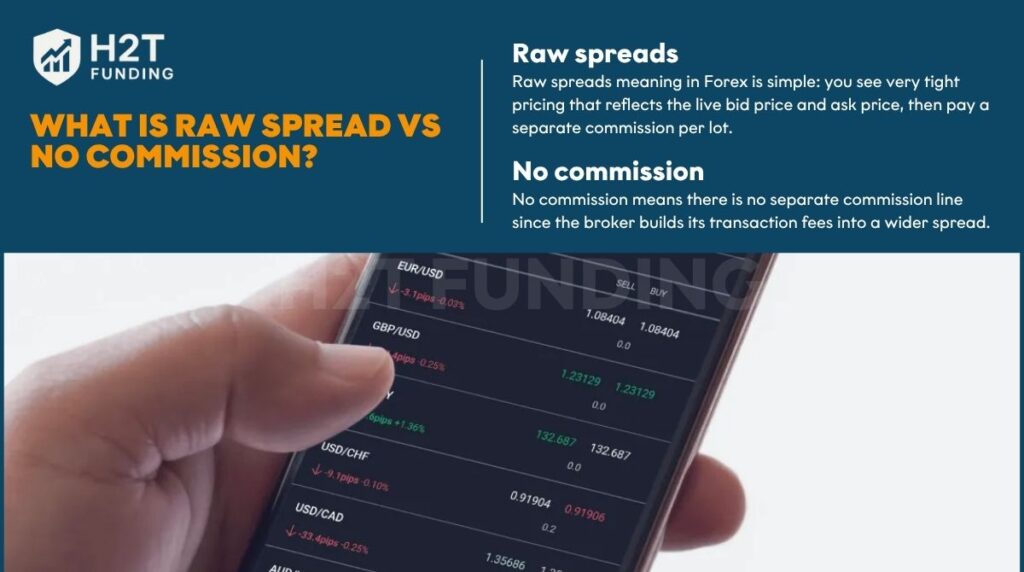
Raw spreads meaning in Forex is simple: you see very tight pricing that reflects the live bid price and ask price, then pay a separate commission per lot.
These tighter spreads can work even better when combined with optimal leverage settings, allowing traders to balance risk and efficiency. In other words, what is raw spread in Forex comes down to accessing near-market prices with full cost transparency.
No commission means there is no separate commission line since the broker builds its transaction fees into a wider spread. This pricing model is one of the main ways prop firms make money, by embedding fees in the spread instead of charging direct commissions.
I think the fastest way to make this click is a simple example. Imagine you trade a major pair where the pip value for one standard lot is ten dollars. With a raw account, you might see a spread close to zero and a round-turn commission of six to seven dollars.
With a no-commission account, you might see a spread of around one pip and zero commission. Which one is cheaper for you depends on how often you trade and how clean your entries are.
Key concepts to lock in and understand in the spread vs commission debate:
- Spread: the distance between the bid and the ask. You start a trade slightly behind because of this gap.
- Commission: a fixed fee per lot that is charged in raw accounts.
- Total trading costs: the real bill is the spread cost plus any commission plus swaps if you hold overnight.
- Why this matters: lower friction improves strategy edge, especially for tight stops and frequent entries.
Put simply: you either pay a small toll each time through a commission with very tight pricing, or you pay a bigger toll inside the spread with no separate fee line. Different wrappers, same goal. We want the wrapper that leaves more profit after costs.
A quick, real-world feel check:
| Item | Raw spread account | No commission account |
|---|---|---|
| Pricing view | Tight bid and ask, close to market | Wider bid and ask with markup |
| Fee line | Commission per lot applied | The commission line is zero |
| Cost transparency | High, easy to audit | Simple to read, less granular |
| Best fit | Scalpers, automated trading, and high-volume trading | Casual trading, swing strategies, predictable costs |
Have you ever watched a breakout and felt your entry got chewed by the spread before the price even moved? That is where tighter pricing can help. On the other hand, if you open a few positions each week and prefer predictable costs, the bundled model can reduce mental load.
Because of that, I always tell readers at H2T Funding to measure how frequently they trade. Then choose the account type that fits the way they actually trade, not the way they wish they traded.
2. How raw spread accounts work
Let’s unpack what really happens inside a raw spread account. In short, you get access to almost the same prices that liquidity providers see the true market bid and ask, but you pay a separate commission for every trade. Many traders, including myself, like this setup because it shows exactly what the broker earns. Nothing is hidden behind inflated spreads.
2.1. Commission structure explained
Every raw spread account follows a commission-based model. The broker connects you directly to market prices with spreads starting as low as 0.0 pip, then adds a fixed commission usually around $3 to $3.5 per side per lot.
So, a round-turn (open and close) costs about $6 to $7 per lot.
Here’s a quick mental math example: If one pip equals ten dollars on a standard lot, then that commission equals roughly 0.6 to 0.7 pip in cost. Meaning, if your spread is near zero, the total fee per trade is still cheaper than a one-pip spread on a standard account.
Honestly, I find this setup refreshing. You know exactly what you pay and can calculate it before clicking buy or sell.
| Metric | Example value | What it means |
|---|---|---|
| Typical spread | 0.0–0.3 pip | Nearly raw market prices |
| Commission (round-turn) | $6–$7 per lot | Charged separately |
| Average total cost | ≈0.6 – 0.7 pip | Still lower than most no-commission setups |
| Transparency | Very high | You can audit every fee |
If you trade ten lots a day, those few tenths of a pip per trade can save you a noticeable amount over a month.
2.2. Trading conditions and execution
Raw pricing shines when your strategy depends on speed and precision. Scalpers, day traders, and algorithmic systems benefit the most because spreads are tighter and orders hit the market faster.
However, tight pricing is only half the story. Execution speed and slippage decide whether you actually capture that advantage. For example, if your broker executes slowly or widens spreads during volatile news, you might lose the benefit.
Execution speed and slippage decide whether you actually capture that advantage. For example, if your broker executes slowly or widens spreads during volatile news, you might lose the benefit, similar to how trailing drawdown rules can impact performance in some prop firm challenges.
That’s why I always test execution by running small live orders during both calm and busy sessions. If you see consistent fills near your intended price, that’s a good sign the broker’s liquidity and cost transparency are real.
Key trading conditions to consider:
- Low latency between order and execution
- Stable spreads during normal volatility
- Reasonable slippage control, especially for stop orders
- Access to interbank liquidity instead of internal matching only
If these boxes are ticked, raw pricing can genuinely cut trading costs and improve performance metrics like win rate and profit factor.
2.3. Advantages and disadvantages of raw spread accounts
Before we weigh the pros and cons, let’s pause for a second. Every account type has its trade-offs, and the raw spread model is no exception. Some traders swear by its precision, while others find the added commission a bit of a hassle. So, what’s the real balance here? Let’s break it down.
Advantages:
- True market pricing: Spreads come directly from liquidity providers with no markup.
- Clear cost structure: You know the commission amount before each trade.
- Ideal for high-volume and automated trading: Lower per-trade cost benefits frequent or algorithmic strategies. These cost savings can also boost your overall profitability, especially if you follow consistent payout rules like those from Take Profit Trader.
- Better execution potential: Tighter spreads mean less initial drawdown when entering positions.
Disadvantages:
- Separate commission adds complexity: You must factor it manually into each trade’s cost.
- Higher minimum deposit: Many brokers set a higher entry threshold for these accounts.
- Less forgiving for small volume: If you trade tiny lots or infrequently, the commission might outweigh the spread savings.
From my own experience, raw spread accounts feel like driving a manual transmission. You get more control and more feedback, but you also have to know what you’re doing. If you enjoy calculating your pip value, managing leverage precisely, and squeezing every cent out of trading costs, this model fits like a glove.
If not, no worries; the next section on no commission (standard) accounts might sound more your speed. But if you’re considering scaling your trading or managing multiple accounts, you might also want to read how many FTMO accounts you can have to plan your setup effectively.
3. How no commission (standard) accounts work
Now, let’s switch gears and look at no-commission accounts, sometimes called standard accounts. These accounts are designed for traders who prefer simplicity, one all-in cost, with no separate commission line to calculate. I get why many beginners choose this setup. It feels cleaner, and you always know what you’re paying for with every click.
3.1. What defines a no-commission model
In a no-commission model, the broker adds its fee directly into the spread. You won’t see a separate line for commission, but you’ll notice that spreads are often wider around 1.0 to 1.5 pips on major pairs.
For example, if the raw spread is 0.1 pip and the broker’s markup equals about 1 pip, you’ll see a total spread of 1.1 pips on your chart. The broker earns its cut from that built-in difference.
Think of it like an all-inclusive ticket: everything is wrapped up in one price. It’s easier to read, though not always cheaper.
3.2. Typical trading conditions
Standard accounts are built for casual traders, swing traders, and newcomers who place a few trades per day or week. The cost difference per trade is small when volume is low, so the convenience outweighs the tiny extra fee.
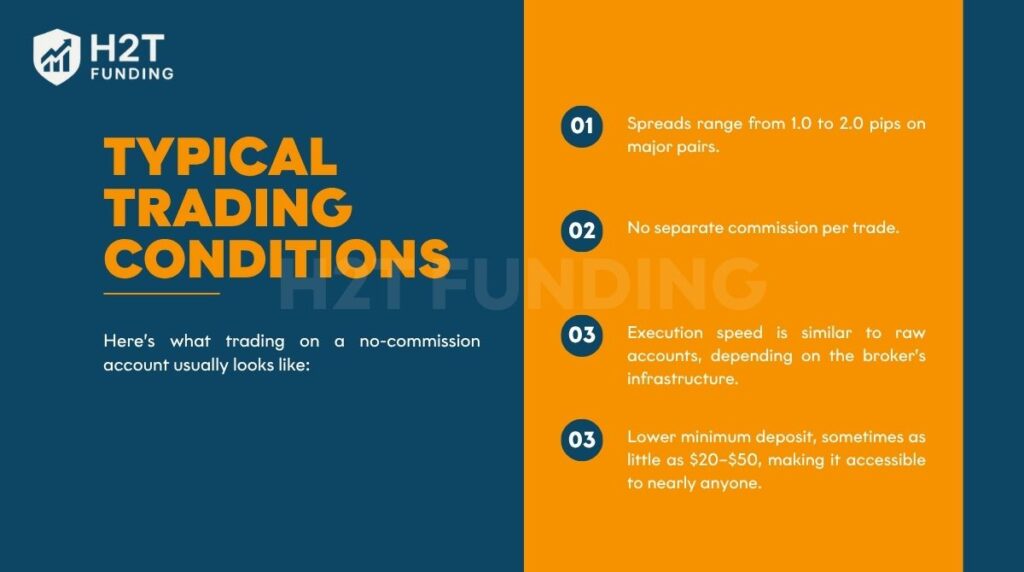
Here’s what trading on a no-commission account usually looks like:
- Spreads range from 1.0 to 2.0 pips on major pairs.
- No separate commission per trade.
- Execution speed is similar to raw accounts, depending on the broker’s infrastructure.
- Lower minimum deposit, sometimes as little as $20–$50, making it accessible to nearly anyone.
From my early trading days, I remember liking this setup because it felt predictable. I didn’t need a calculator for each order; I just looked at the spread and traded. For small accounts or longer-term trades, that convenience really matters.
3.3. Advantages and disadvantages of no commission accounts
Before you decide, it helps to see both sides clearly.
Advantages:
- Simple fee structure: One spread covers all trading charges, so there’s nothing to calculate.
- Lower entry requirement: It’s easy for new traders to start with small deposits.
- Predictable costs: You know exactly what each trade will cost upfront.
- Beginner-friendly: No need to manage commission reconciliation or conversion.
Disadvantages:
- Wider spreads mean higher trading costs for active traders.
- Less transparency. It’s harder to see how much of the spread is broker markup.
- Not ideal for scalping or high-frequency strategies.
In my opinion, standard accounts feel like automatic cars: easier to drive and more forgiving, but less precise. Great for learning or part-time trading, but full-time traders usually switch to raw spread accounts for lower costs.
4. Raw spreads vs no commission: Side-by-side comparison
Now that we’ve looked at how each account type works, let’s put them head-to-head: a raw spread vs standard account comparison that shows how pricing models differ in real conditions. I’ll use real-world averages based on what most regulated brokers (like Pepperstone, FP Markets, or Exness) currently offer.
| Criteria | Raw spread account | No commission account |
|---|---|---|
| Average spread | 0.0–0.3 pip | 1.0–1.5 pips |
| Commission (per round-turn lot) | $6–$7 | $0 |
| Approx. total cost per lot | ≈0.6 – 0.7 pip | ≈1.1 – 1.5 pips |
| Minimum deposit | $200–$250 | $20–$50 |
| Cost transparency | Very clear (fees separated) | Moderate (fees built into spread) |
| Execution speed | Usually faster due to ECN routing | Slightly slower due to internal matching |
| Best for | Scalpers, automated trading, high-volume traders | Swing traders, beginners, casual traders |
| Trading flexibility | High (can fine-tune risk and cost) | Easy (plug-and-play simplicity) |
When you line them up this way, you can see the trade-off instantly. The raw spread model gives you precision and lower long-term cost, while the standard model gives you predictability and simplicity.
The key difference between raw spreads vs no commission and even raw spread vs zero spread models is how brokers structure their costs. Raw spreads deliver tighter pricing with a separate commission for precision, while zero-spread or no-commission accounts bundle broker fees inside slightly wider spreads for predictable costs.
Here’s how I like to put it:
- If you’re a scalper or trade multiple times a day, every pip counts. Over a hundred trades, saving half a pip per trade means you’re already ahead.
- If you’re a swing or position trader, paying a few extra pips here and there barely changes the big picture, and the simplicity is worth it.
Mini conclusion: If your trading style relies on tight entries and frequent execution, the raw spread model will usually save you money in the long run. But if you just want clean, straightforward costs without thinking about commissions, the no-commission setup might feel much more comfortable.
Either way, what matters most is consistency. A trader who understands their fee structure and adjusts position sizing properly will always outperform someone who doesn’t know how much each trade truly costs.
5. How these account types affect your trading strategy
Here’s where the real impact shows. Choosing between raw spread and no commission isn’t only about cost; it also shapes how your strategy behaves. I learned this the hard way after testing both across different setups for scalping, swing trading, and running automated bots. The same strategy can perform completely differently depending on your cost model.
5.1. For scalpers and high-volume traders
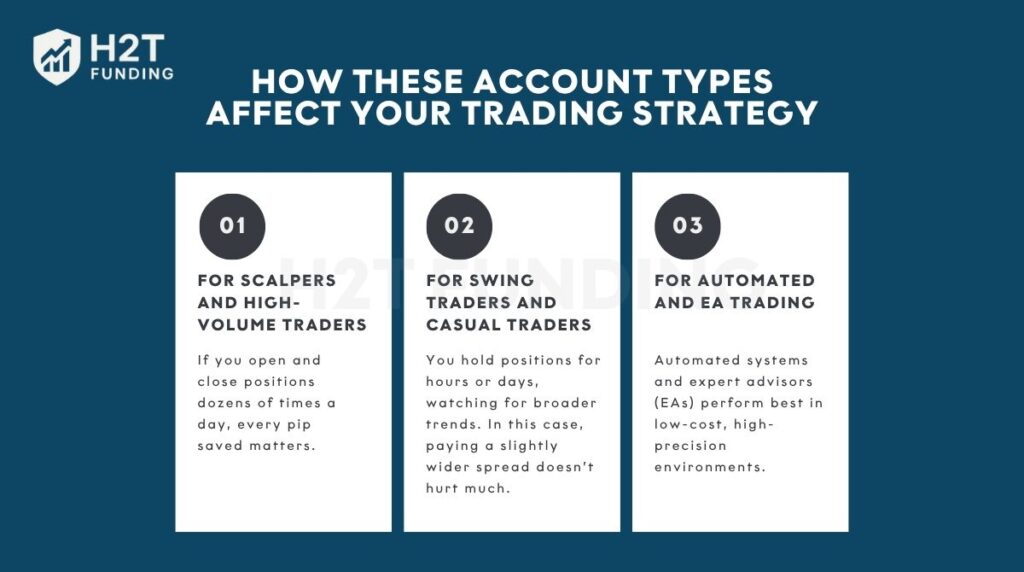
If you open and close positions dozens of times a day, every pip saved matters. Scalpers rely on tight entries and minimal friction, so the raw spread model fits naturally. Even when you add commission, total trading costs remain lower because spreads stay razor thin.
For instance, imagine a scalper making 50 trades daily. A difference of just 0.4 pip per trade equals 20 pips saved each day; that’s $200 saved per standard lot every month. Small change per trade, big difference over time.
Still, execution speed becomes critical here. A raw spread account only delivers real benefits if your broker provides fast order routing and low slippage. I always recommend testing order fills during volatile hours to confirm you’re truly getting the edge those spreads promise.
5.2. For swing traders and casual traders
Now, let’s say you’re trading a few times a week. You hold positions for hours or days, watching for broader trends. In this case, paying a slightly wider spread doesn’t hurt much. The simplicity of a no-commission account helps you focus on analysis instead of calculating every cent of cost.
Also, wider spreads can feel less stressful for those who don’t need pinpoint accuracy on entries. You just need predictable costs and a platform that feels comfortable. That’s why many swing traders I know prefer standard accounts: fewer moving parts to manage and more mental energy for strategy.
5.3. For automated and EA trading
Automated systems and expert advisors (EAs) perform best in low-cost, high-precision environments. When your algorithm fires hundreds of trades based on micro-movements, raw pricing becomes essential. The tighter the spread, the better the fill.
However, I’ve also seen bots malfunction when brokers widen raw spreads unexpectedly during low liquidity. So, if you run automation, always monitor average spreads during different sessions and adjust lot size or risk parameters.
Bottom line when choosing between raw spreads or no commission:
- Scalpers and high-volume traders → raw spread offers sharper execution and lower costs.
- Swing and casual traders → no commission keeps things simple and predictable.
- EA or algorithmic traders → raw spread maximizes efficiency but requires careful monitoring.
I like to think of it this way: if trading is your craft, raw spreads are your precision tools. If trading is your hobby or part-time venture, no commission gives you a smoother ride. Both can work beautifully as long as they match your rhythm.
6. Cost transparency and risk management
Let’s talk about something most traders overlook until it hurts: how fee transparency affects your risk management. Trading costs aren’t just numbers buried in reports; they shape how much room your trades have to breathe. When I started trading, I underestimated this part, and honestly, it cost me more than one good setup.
Why transparency matters: when you know exactly how much each trade costs, the spread, the commission, and even the overnight swap, you can plan entries and exits with precision. Hidden fees, on the other hand, quietly eat into your edge, especially if you trade often.
In raw spread accounts, the cost breakdown is clean. You see a near-zero spread and a fixed commission. That’s it. You can calculate your risk-to-reward ratio with full accuracy before opening a position. For traders who use tight stop-losses or high leverage, this clarity is priceless.
In no-commission accounts, things look simpler but are actually harder to measure. The broker’s markup is built into the spread, so you don’t always know how much of it is actual market movement versus the fee. It’s not necessarily bad, just less precise.
Here’s a quick side-by-side view:
| Aspect | Raw spread account | No commission account |
|---|---|---|
| Fee visibility | Full (commission listed separately) | Limited (embedded in spread) |
| Risk control | Easier to calculate per trade | Harder to isolate the true cost |
| Budgeting | Suitable for detailed cost tracking | Suitable for predictable totals |
| Common mistake | Forgetting to include swaps or holding costs | Assuming all spreads are the same |
I always tell new traders this: your real risk isn’t only market volatility; it’s also cost volatility. A sudden widening of spreads during a news event can shift your stop-loss earlier than planned, turning a good trade into a losing one.
A few habits help avoid that:
- Check the average spread history on your broker’s site, not just the “from 0.0 pip” claim.
- Track your daily transaction fees to see how much you truly pay per session.
- When using leverage, recalculate your margin requirement after factoring in total trading costs; it keeps your risk ratio realistic.
So, when someone asks me which model is safer, I usually reply, the one that makes you more aware. Because in trading, clarity is a form of protection.
7. How brokers make money in each model
In a raw spread account, the broker usually charges a fixed commission per lot, around six to seven dollars for a round turn. In return, you get nearly the same forex market prices that liquidity providers see. I like this model because it feels transparent. You can calculate your cost before you even click buy or sell.
The fee is right there, simple and measurable. Some brokers might also earn a small rebate from their liquidity partners based on total trading volume, but that does not change your price. What matters is that you always know exactly what you are paying for.
Most traders rarely stop to think about how their broker actually earns. I didn’t either, at least not in my early trading days. But once you figure it out, the small details like transaction fees, price markup, and even the way orders are filled start to make sense.
Now let’s look at no-commission accounts. Here, the broker builds its earnings into a slightly wider spread. Instead of showing a commission line, it widens the bid and ask prices a little. If the real spread is 0.1 pip, you might see 1.1 pips on your screen, and that extra one pip is the broker’s income.
That is called a price markup. I remember when I first compared both types of trading EUR/USD in a live account. At first, the spread-only model looked easier, but after a few weeks, those tiny markups quietly added up to more than I expected.
So, how do we simplify it? Raw spread accounts are like paying a clear entry ticket. No commission accounts are like an all-inclusive price that hides the ticket inside the total cost. Neither model is wrong; it depends on your trading strategy and how much control you want over your costs and leverage.
From my experience, raw pricing rewards precision. It suits traders who care about every pip, especially those running automated systems or trading multiple asset classes. The no-commission model, on the other hand, offers peace of mind. It works better for casual traders who just want a smoother trading experience without calculating every cent.
In the end, brokers make money by facilitating your trades, not by tricking you. What matters is understanding where your money goes so you can choose the model that feels fair and fits the way you trade.
8. Which is better: Raw spread or no commission?
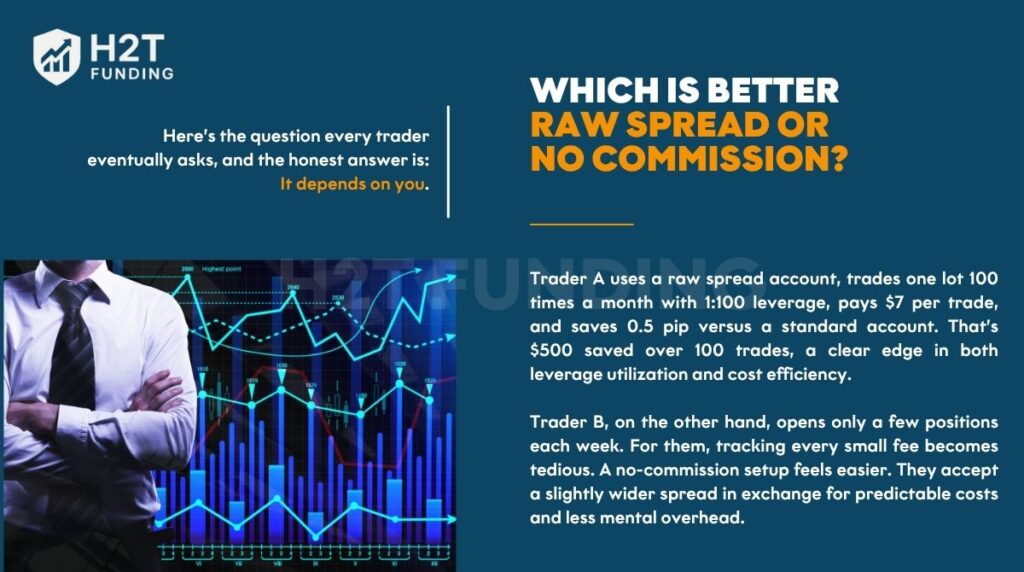
Here’s the question every trader eventually asks, and the honest answer is: It depends on you. Each account type solves a different problem. The real task is figuring out which one fits your trading rhythm, risk tolerance, and level of experience.
From what I’ve seen in both my own trades and those of H2T Funding’s readers, raw spread accounts shine when you prioritize precision and volume. The pricing is lean, transparent, and efficient. It feels like driving a sports car: responsive, powerful, but demanding full attention. If you scalp or rely on quick entries, every tenth of a pip saved adds up.
Let’s look at a quick reality check. Trader A uses a raw spread account, trades one lot 100 times a month with 1:100 leverage, pays $7 per trade, and saves 0.5 pip versus a standard account. That’s $500 saved over 100 trades, a clear edge in both leverage utilization and cost efficiency.
Trader B, on the other hand, opens only a few positions each week. For them, tracking every small fee becomes tedious. A no-commission setup feels easier. They accept a slightly wider spread in exchange for predictable costs and less mental overhead.
So, who wins?
| Trader Profile | Best Choice | Why |
|---|---|---|
| Scalper/High-frequency | Raw Spread | Lowest friction and more accurate cost tracking |
| Automated / EA user | Raw Spread | Execution precision and tight spread stability |
| Swing / Long-term | No Commission | Simplicity and steady pricing |
| Beginner | No Commission | Lower learning curve and fewer moving parts |
Still, there’s a catch. The cheapest structure on paper doesn’t always mean the most profitable outcome. Poor execution speed or excessive slippage can easily wipe out the benefit of lower fees.
My personal rule? Start with the model that makes you most confident in your math. If that’s raw pricing with clear numbers, go for it. If that’s an all-inclusive spread so you can focus on charts instead of costs, stick with that, especially if your goal is to pass a prop firm challenge successfully and prove consistency under real trading conditions.
You can always test both using demo accounts, or even take the next step by learning how to get a funded trading account, a practical way to apply your strategy under real market conditions with firm capital.
Trading is about alignment. When your cost model, strategy, and psychology move in sync, that’s when performance improves. Developing this mindset takes discipline, something every trader can strengthen by learning how to be more disciplined in their trading. Not because one account type is magically better, but because it lets you trade with fewer surprises and clearer decisions.
9. FAQs: Common questions about raw vs no commission accounts
If you’re just starting, a no-commission account usually makes more sense. You can focus on learning price action and risk management without worrying about separate fee calculations. Once you gain confidence and start trading more frequently, switching to a raw spread account can help you save on long-term costs.
Most brokers charge around $6–$7 per standard lot for a round-trip trade (both entry and exit). Some ECN brokers might offer slightly lower rates for higher trading volumes. Always check your broker’s commission schedule before opening an account.
Not if you’re trading with a transparent broker. The fees are visible; you’ll see the commission right on your statement. However, keep an eye out for swap rates, inactivity fees, or withdrawal charges, as those apply across all account types.
Many reputable brokers provide both options, such as Pepperstone, Exness, FP Markets, and Tickmill. They usually let you open multiple account types under one profile, so you can test which model suits your strategy best.
Yes, most brokers allow that. You can request a conversion or simply open a new account under the same profile. I often keep one raw account for high-frequency strategies and one standard account for swing trades.
Neither is universally better; it’s about your style. Paying commission with a tight spread benefits frequent traders, while paying a built-in spread works best for low-volume or long-term traders. The goal is to minimize total cost relative to your trade size and frequency.
“Raw” means unmarked, or straight from the market. The broker passes the exact bid and ask prices from liquidity providers to your platform, without adding their own markup. You then pay a small fixed commission instead.
A raw spread account shows you near-market bid and ask prices, then charges a small commission for every lot traded. A standard account, sometimes called a no-commission account, hides that fee inside a wider spread. I often explain it like this: raw gives you transparency, standard gives you simplicity.
It depends on how often you trade. If you place many trades each day, raw spreads are usually cheaper because tighter pricing offsets the commission. But if you trade less often, the wider spread in a no-commission setup might not hurt your bottom line much.
Not if you trade with a transparent broker. The only visible cost is the commission. Still, remember that transaction fees like swaps or overnight charges apply to both account types. Always check your statement to make sure you understand every deduction.
Yes, almost always. Scalpers need tight spreads, fast execution, and consistent fills. In my own tests, raw pricing saved several pips over time, which can make a huge difference when you’re running short-term trading strategies.
They can, but it might feel a bit technical at first. You’ll need to track both the spread and the commission. If you’re just learning, start with a no-commission account until you get comfortable managing leverage and order size.
Most brokers charge around six to seven dollars per round-trip lot. A few offer discounts for high-volume traders or loyalty tiers. It’s not a random number; it’s part of how brokers stay consistent across the forex market.
Usually, yes. These accounts are often connected to ECN or STP networks, where orders go straight to liquidity providers. That means less internal matching and lower latency, which improves execution quality.
Many regulated brokers like Pepperstone, FP Markets, Exness, and IC Markets offer real raw pricing. I’ve personally tested several of them, and the best ones keep spreads stable even during volatile sessions. Always confirm the model before funding your account.
Add the spread cost (in pips) and the commission per lot. For example, if the spread equals 0.2 pip and commission is seven dollars, the total cost is roughly 0.7 pip per round turn. It’s basic math, but many traders forget to do it and later wonder why profits seem smaller.
Spread-only means the broker includes its fee inside the bid-ask gap. Raw pricing shows the real spread and adds a separate commission. The result can be similar, but the raw model is easier to measure precisely.
At HeroFX, the raw spread account displays live interbank prices and adds a commission per lot. The zero-commission account builds the broker’s markup directly into the spread. So one gives you tighter pricing with a fee line, the other gives you simplicity without a visible commission.
10. Conclusion
In the end, the choice between raw spreads vs no commission comes down to your trading rhythm and priorities. If you value precision, tighter pricing, and clear cost visibility, the raw spread model usually delivers better long-term efficiency. If you prefer simplicity and predictable costs, the no-commission setup makes trading easier and less stressful.
At H2T Funding, we always remind traders that understanding your fee structure is part of mastering the game. Inside our Prop Firm & Trading Strategies category, we help traders compare cost models, refine execution, and choose the setup that truly supports consistent growth.