



If you are trying to figure out how to use trendlines in trading, you’re already focusing on one of the most practical skills in Forex. A well-drawn trendline can help you see where the market is heading, spot potential entry points, and avoid chasing random price moves.
For me, trendlines have been a constant lesson. Good trades often came from respecting a clear trendline, while some of my worst losses happened when I convinced myself to ignore one. It’s not just theory; it’s a practical skill that pays off.
In this guide, we will dive deep into technical analysis, covering what trendlines are, how to draw them properly, and how to turn them into strategies. Mastering the art of using trendlines for trading will allow you to turn simple lines into powerful strategies.
Key takeaways
- Trendlines are straight lines that connect at least two swing highs in a downtrend or two swing lows in an uptrend, helping traders visualize market direction and structure.
- Practical strategies when using trendlines include trading bounces for continuation and breakouts for reversals. Both require patience, confirmation, and strict risk management.
- Advanced use of trendlines, such as multiple timeframe analysis or combining with Fibonacci retracement, improves accuracy and filters out false signals.
1. What are trendlines, and why do they matter in trading
A trendline is a straight line that connects at least two significant price points on a chart, usually highs in a downtrend or lows in an uptrend. For Forex traders, it acts as a visual guide to identify the market’s overall direction.
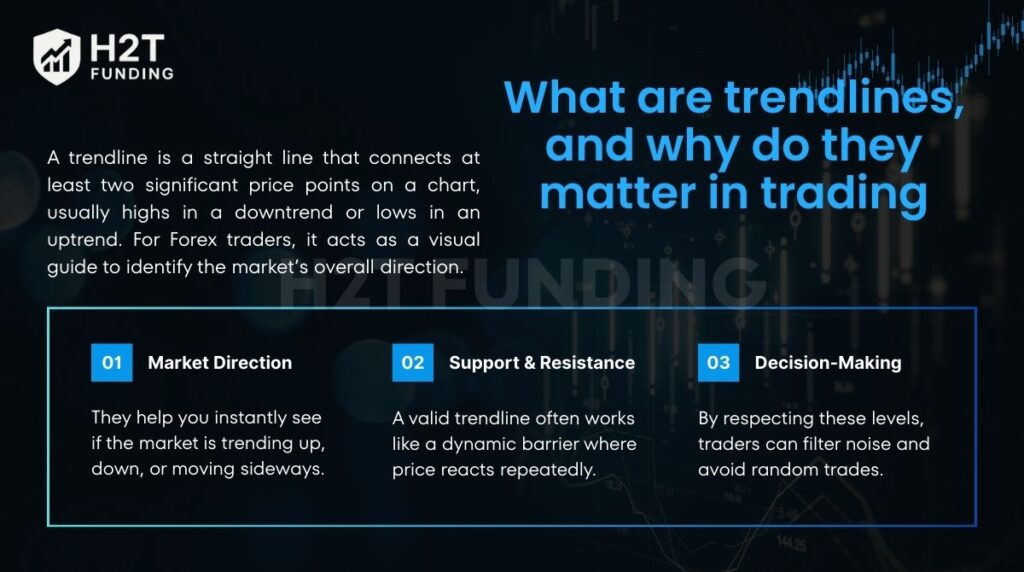
Trendlines matter for three key reasons:
- Market Direction: They are essential tools to identify long-term market trends, helping you instantly see the general price direction, whether the market is trending up, down, or moving sideways.
- Support & Resistance: A valid trendline often works like a dynamic barrier where price reacts repeatedly.
- Decision-Making: By respecting these levels, traders can filter noise and avoid random trades.
I’ve noticed beginners often dismiss them as “too simple.” But that simplicity is their strength. If you ignore them, you’ll likely end up chasing price without a plan, a mistake we’ve all made.
2. How to draw trendlines in trading
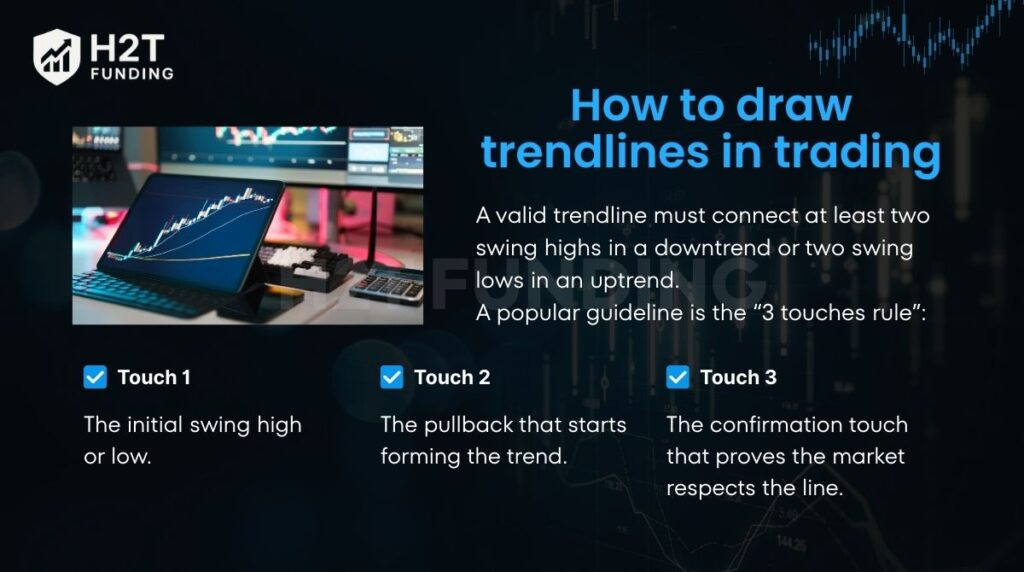
Learning how to draw trendlines in forex trading is the first step to making them useful in practice on your charting platform. A valid trendline isn’t just any line on a chart; it must connect at least two swing highs in a downtrend or two swing lows in an uptrend.
In Forex, trendlines work best when drawn on higher timeframes like the 4H or daily chart. These timeframes filter out random noise and create clearer swing highs/lows that most traders recognize.
The more times the price touches and respects the line, the stronger that trendline becomes. A popular guideline is the “3 touches rule”:
- Touch 1: The initial swing high or low.
- Touch 2: The pullback that starts forming the trend.
- Touch 3: The confirmation touch that proves the market respects the line.
After this third touch, many traders consider the trendline validated and may look for trade entries, especially when combined with price action signals like rejection candles or engulfing patterns. Anything before that is just a theory waiting for proof.
When it comes to precision, the difference between valid and invalid trendlines matters:
- A valid trendline connects obvious highs or lows that most traders can see, often using candle wicks to capture the true extremes.
- An invalid trendline forces connections, cuts through multiple candles, or shows no consistent market reaction.
Some common mistakes include forcing lines to fit a bias, redrawing them too frequently, or ignoring higher timeframes. In reality, no trendline is perfect. It’s better to think of it as a zone, not a razor-sharp line. Being flexible and waiting for confirmation is what separates a good setup from a random guess.
3. Best Forex pairs and timeframes for drawing trendlines
Not all Forex pairs respect trendlines equally. In general, major pairs tend to produce cleaner trend structures because of higher liquidity and smoother price movement.
Forex pairs that often work well with trendlines include:
- EUR/USD
- GBP/USD
- USD/JPY
- AUD/USD
- USD/CHF
Cross pairs and more volatile instruments (such as GBP/JPY) can still respect trendlines, but they often produce sharper swings and more frequent false breakouts. This means traders may need stronger confirmation signals, wider stop-loss buffers, and stricter risk control when trading them.
Timeframe also plays a major role in trendline reliability. Higher timeframes usually provide clearer trend structure and reduce noise:
- Daily (D1): best for identifying the main market trend
- 4H (H4): ideal for swing trading and structured setups
- 1H (H1): useful for intraday trading but more sensitive to noise
Many traders draw trendlines on D1 or H4 first. However, if you want to know how to use trendlines for intraday trading, zooming into the 1H or 15M charts allows you to catch shorter moves. Though it requires more discipline because price fluctuations and fake breaks happen more frequently.
4. Types of trendlines you need to know
Trendlines may look simple, but they come in different forms, each serving a unique purpose in market analysis. Knowing the main types will help you apply the right one depending on whether you want to follow momentum, identify static levels, or adapt to dynamic price action.
4.1. Uptrend and Downtrend Lines
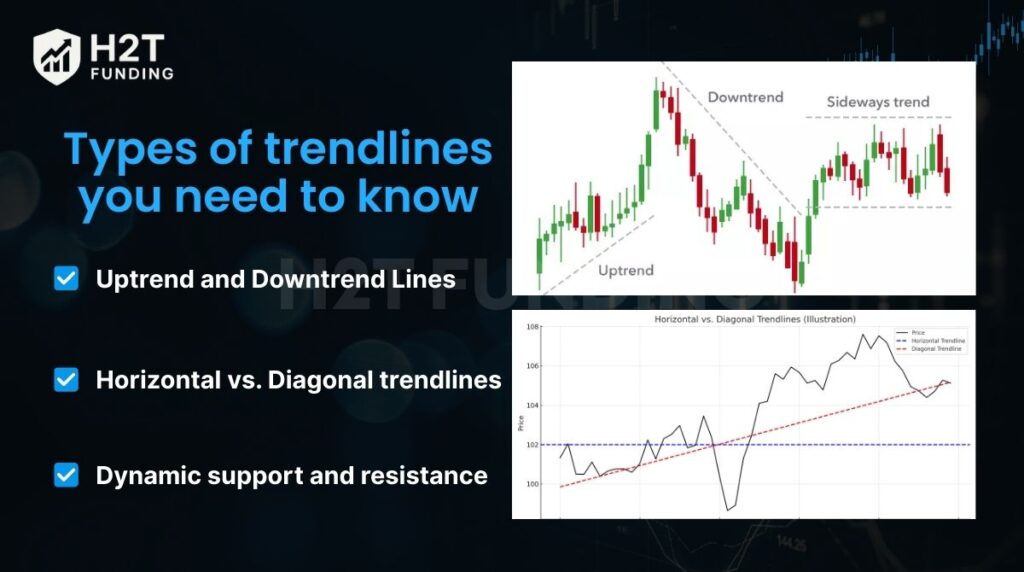
An uptrend line connects a sequence of higher lows, while a downtrend line links lower highs. These lines give traders a clear picture of who is in control of the market.
- Uptrend line: Shows buyer strength and potential buy zones on pullbacks.
- Downtrend line: Highlights seller dominance and possible short entries during rallies.
The more times the price touches these lines without breaking, the more reliable they become.
4.2. Horizontal vs. Diagonal trendlines
Trendlines can be either flat or sloped, and each style reveals different aspects of price behavior.
- Horizontal trendlines mark static support and resistance levels. They’re simple but powerful, especially around key psychological prices like 1.2000 on EUR/USD.
- Diagonal trendlines slope upward or downward, adapting to the market’s momentum. They capture the “dynamic” movement of price, showing evolving support in uptrends or resistance in downtrends.
A useful approach is to combine both: when a diagonal trendline aligns with a horizontal level, the reaction point often becomes stronger and more reliable. Additionally, by drawing a parallel line to your trendline, you can create channels that help define overbought and oversold areas within the trend.
4.3. Dynamic support and resistance
Unlike fixed horizontal levels, trendlines are not static. They move with price, which makes them useful as dynamic support and resistance that evolves as the trend develops.
- In an uptrend, a rising trendline connects higher swing lows and acts as a support zone where buyers often step in.
- In a downtrend, a falling trendline connects lower swing highs and works as resistance, where selling pressure may increase.
However, this flexibility comes with an important limitation: trendlines remain valid only as long as the market continues to respect them. If the price repeatedly cuts through the line without a meaningful reaction, the trendline loses significance and should be adjusted or removed.
Timeframe also plays a key role in reliability. Trendlines drawn on higher timeframes (daily or weekly) tend to carry more weight because they reflect stronger market structure, while lower timeframes are more vulnerable to noise and false breaks.
Overall, trendlines provide a moving framework that helps traders follow trend direction, anticipate pullbacks, and identify potential reversal zones, but they must be updated regularly to stay accurate and useful.
5. How to use trendlines in trading
Drawing a line is one thing, but knowing how to trade Forex with trendlines is where they become truly valuable. Traders generally use them in two main ways: trading the bounce or trading the breakout. Both approaches can be enhanced by combining trendlines with other price action signals.
5.1. Trendline bounce strategy (Support/Resistance)
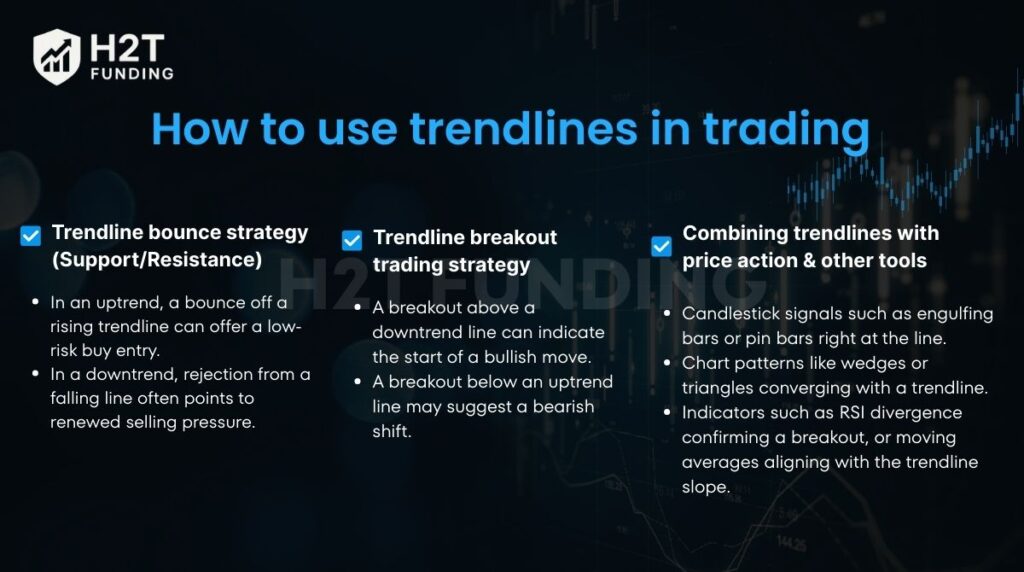
The bounce strategy treats trendlines as dynamic support or resistance. When the price approaches a well-respected line, traders look for signals that confirm rejection before entering.
- In an uptrend, a bounce off a rising trendline can offer a low-risk buy entry.
- In a downtrend, rejection from a falling line often points to renewed selling pressure.
Patience is key here: waiting for candlestick confirmation (e.g., a pin bar or bullish engulfing) avoids false signals. Equally important is planning the exit. If the price closes beyond the trendline, it often signals the end of that trade idea, allowing you to lock in profits or cut losses systematically.
5.2. Trendline breakout trading strategy
The trendline breakout trading strategy is popular because it captures potential reversals or accelerations in market momentum.
- A breakout above a downtrend line can indicate the start of a bullish move.
- A breakout below an uptrend line may suggest a bearish shift.
However, breakouts are risky because false signals are common. Strong traders usually wait for:
- A candle close beyond the line.
- A retest of the broken line as new support/resistance. This phenomenon, often called a trendline flip, is where a broken support line turns into resistance (or vice versa), offering a high-probability entry.
- Confluence with other indicators like RSI, MACD, or volume spikes.
Breakouts also guide exits: when a line that supported a trade finally breaks, it’s often a signal to secure profits and stand aside until a new setup forms.
5.3. Combining trendlines with price action & other tools
Trendlines are far more effective when combined with price action and technical indicators. Examples include:
- Candlestick signals, such as engulfing bars or pin bars, right at the line.
- Chart patterns like a wedge pattern or triangles are converging with a trendline.
- Indicators such as RSI divergence confirming a breakout, or moving averages aligning with the trendline slope.
Timeframe is also crucial: a line drawn on a daily chart carries more weight than one on a 5-minute chart. Aligning signals across multiple timeframes reduces noise and builds confidence in the setup.
When you combine trendlines with these tools, they stop being just lines on a chart. They become a core part of your trading plan, helping you find better entries and exits with more confidence. A solid trading plan also includes risk control and discipline, such as tracking your trading expenses to keep your performance measurable over time.
5.4. Trendlines in sideways markets (consolidation and fake breaks)
Trendlines work best in trending markets. In sideways conditions, price often cuts through trendlines repeatedly without meaningful follow-through. This is why many traders get trapped by false breakouts during consolidation phases.
To avoid this, traders should:
- Identify whether the market is forming a range (flat highs/lows)
- Avoid drawing steep trendlines inside choppy price action
- Wait for a candle close and confirmation, not intrabar spikes
- Use additional filters such as volume expansion or RSI momentum shift
In Forex, false breaks are common around news releases. A trendline may break briefly, trigger stop-losses, then snap back into the range. This is why confirmation and patience matter more than speed.
6. Advanced applications of trendlines
Once you master the basics, trendlines can be taken further with advanced strategies. These techniques help experienced traders refine their analysis and add more depth to their trading decisions.
6.1. Using multiple timeframes
A trendline on a single chart may look convincing, but checking it across different timeframes gives stronger confirmation.
- On the daily chart, a trendline might show the broader market direction.
- On the 1-hour chart, the same line may highlight short-term entry opportunities.
From experience, confluence between higher and lower timeframes usually signals stronger setups. If a trendline holds on the 4H and daily charts, I pay much more attention to it when planning trades.
6.2. Trendlines with Fibonacci retracement
Another effective method is combining trendlines with Fibonacci retracement levels. When a retracement level (e.g., 38.2% or 61.8%) aligns with a trendline, it often creates a powerful reaction zone.
- This combination highlights potential reversal points where the price may bounce.
- It also helps in timing entries and exits with higher precision.
For example, if EUR/USD pulls back to a 50% Fibonacci retracement that aligns with an uptrend line, it becomes a strong area to watch. If price action confirms the level, it may offer a solid long opportunity.
6.3. Trendline confluence with indicators
Beyond chart patterns, trendlines can also be paired with indicators like RSI, MACD, or moving averages.
- RSI divergence near a trendline break adds credibility to the signal.
- Moving averages crossing around a trendline may confirm momentum shifts.
By combining indicators with trendlines, traders elevate a basic line into a more dependable signal, framed within a broader trading plan that boosts decision-making confidence.
6.4. Using trendlines with market structure (higher highs and lower lows)
Advanced traders often combine trendlines with market structure confirmation. A trendline bounce becomes more reliable if the market is also printing:
- Higher highs and higher lows (bullish structure)
- Lower highs and lower lows (bearish structure)
For example, if EUR/USD respects an uptrend line on the 4H chart and continues forming higher lows, the trendline becomes more than a visual guide. It becomes a confirmation of a bullish structure.
This is also the kind of structured confirmation many traders rely on when learning how to pass the FTMO challenge, because consistency matters more than “perfect entries.”
7. Risk management in trendline trading
Trendlines are not just tools for spotting market direction or trade entries; they also play a vital role in risk management. Integrate them into your trading plan, and you can protect capital, size positions more effectively, and avoid common pitfalls such as false breakouts.
Tip: To build confidence in this approach, it’s smart to practice trendline-based setups in a demo trading account before risking real capital.
7.1. Stop-loss placement near trendlines
One of the most practical ways to use trendlines is for setting stop-loss orders. A stop placed slightly beyond a valid trendline, below it in an uptrend or above it in a downtrend, offers protection if the market breaks structure.
- This method prevents small intraday noise from knocking you out too early.
- At the same time, it safeguards against larger losses if the trendline fails.
From experience, this approach enforces discipline. Instead of moving stops impulsively, I let the market prove me right or wrong based on whether it respects the trendline.
7.2. Position sizing and volatility consideration
Trendlines also guide traders in position sizing. The distance between the entry and the stop-loss (often just beyond the line) defines the risk per trade. By knowing this distance, you can adjust the lot size so that the risk matches your tolerance, typically 1–2% of account equity.
Because risk tolerance is deeply connected to your overall financial situation, learning how to budget and manage expenses can indirectly improve your risk management decisions.
Additionally, volatility matters: in fast-moving markets, prices often pierce lines more aggressively. Allowing some buffer when sizing trades helps reduce premature stop-outs. This keeps the risk-reward ratio realistic while aligning with your overall strategy.
7.3. Avoiding false breakouts and overfitting
Many traders lose money by reacting too quickly to every touch or break of a line. False breakouts are common; the price may briefly push past a trendline before snapping back.
Ways to reduce this risk include:
- Waiting for the candle to close rather than reacting intrabar.
- Looking for retests of the broken line as confirmation.
- Combining trendlines with other signals (candlestick patterns, momentum indicators).
Another danger is overfitting, where a trader forces lines to match every price move. A cluttered chart creates confusion instead of clarity. Using only the most obvious and respected trendlines keeps analysis clean and objective.
8. Trader psychology and discipline when using trendlines in trading
Trading with trendlines is as much a psychological challenge as it is a technical one. Even accurate analysis can fail if decisions are driven by fear, greed, or bias instead of discipline. Recognizing these mental traps helps traders stay consistent.
8.1. Avoiding emotional trading decisions
One of the biggest obstacles in trendline trading is confirmation bias. Traders often “see” what they want to see, forcing a line to match their bullish or bearish view. This leads to overtrading and selective interpretation of price action. The disciplined approach is to:
- Validate decisions with multiple signals, not just a single trendline.
- Stay patient and wait for clear confirmations (e.g., strong bounce, clean break).
- Accept that not every setup deserves a trade.
8.2. When to redraw or remove a trendline
A common question is: “When should I redraw a trendline?” The answer lies in market behavior. If the price repeatedly ignores the line or cuts through it without reaction, it has lost relevance. Holding on to outdated lines creates false expectations. A practical habit is to:
- Redraw when new swing highs/lows form.
- Remove lines that no longer act as support or resistance.
- Keep charts clean to avoid clutter and confusion.
8.3. Treating trendlines as guidelines, not guarantees
The single most important mindset shift is this: treat trendlines as guides, not unbreakable rules. The market doesn’t owe your line anything. Relying too heavily on one line is a recipe for disappointment. A balanced approach is to:
- Use trendlines alongside other tools (candlestick patterns, indicators, volume).
- Always plan for the scenario where the line breaks.
- Focus on managing risk rather than chasing “perfect” setups.
In short, the psychology of trendline trading comes down to discipline: staying objective, updating your analysis as the market evolves, and never treating a line as infallible. Those who embrace this mindset tend to avoid costly mistakes and trade with more consistency over time.
This kind of discipline is also crucial if you plan to choose a prop firm, where consistent risk management and rule-based trading matter more than occasional big wins.
9. Practical examples and case studies
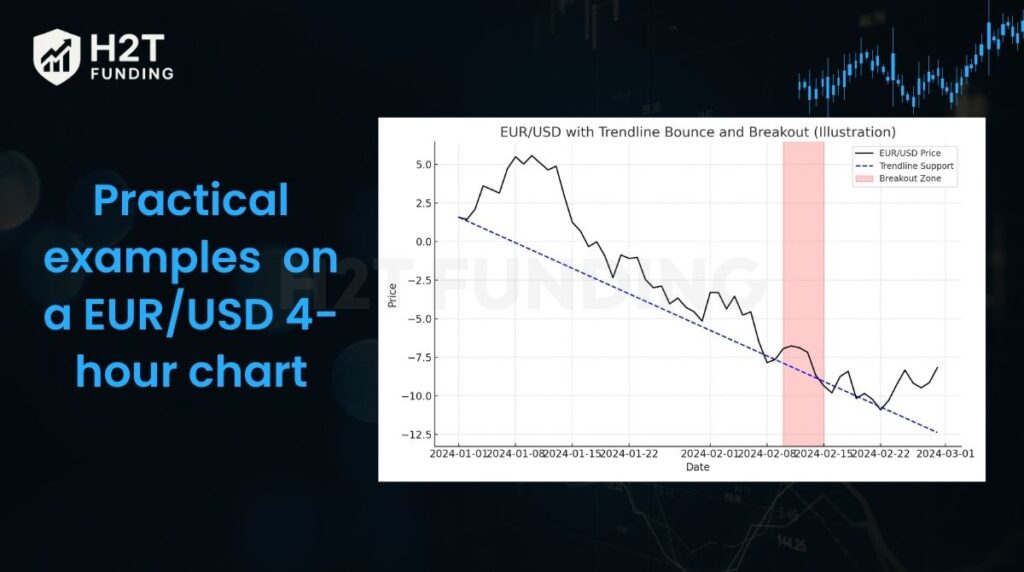
Let’s look at a real-world trend line example to see how these concepts apply to live charts. For example, on a EUR/USD 4-hour chart, connecting two higher lows created a clean uptrend line that acted as dynamic support for several weeks.
Each time the price touched the line and formed bullish candlesticks, traders witnessed a sharp trendline takeoff, allowing them to enter long with controlled risk as momentum accelerated. This is a classic case where patience and confirmation led to a successful trade.
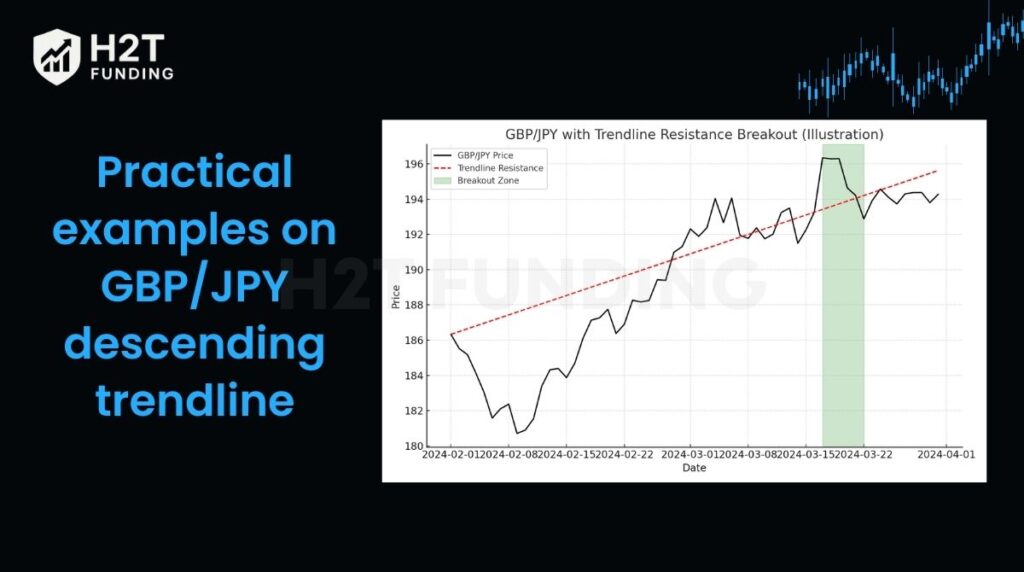
On the other hand, not all setups work as expected. A GBP/JPY descending trendline once connected multiple lower highs, serving as resistance for several sessions. Many traders sold each time the price approached it.
But when the pair finally broke through decisively, those who entered shorts too early without waiting for confirmation suffered losses.
From these examples, several lessons stand out. Trendlines are time-sensitive: A line that holds on the daily chart may need constant adjustment on lower timeframes.
Not every touch deserves a trade; confirmation from candlesticks, volume, or confluence with other tools raises the probability of success.
And above all, trend lines are guides, not guarantees. In most cases, when price consistently ignores them, the best move is to withdraw or remove them rather than cling to outdated analysis.
10. FAQs about trendline trading
Trendline trading is reliable when used correctly, but not foolproof. Its reliability increases when combined with other confirmations, such as candlestick patterns, indicators, or confluence with support and resistance zones. Treat trendlines as guides, not guarantees.
Higher timeframes, like the daily or 4-hour chart, generally produce more reliable trendlines because they filter out market noise. Lower timeframes can work for short-term trades but are prone to false signals.
Yes, but it’s risky. Trendlines alone give structure but don’t always confirm momentum or reversals. Adding tools like RSI, MACD, or moving averages provides extra confirmation and reduces false entries.
Trendlines can be applied in two main ways: entering on bounces when the price respects the line, or trading breakouts when the price moves through it and confirms with a retest. Both approaches work best when paired with price action signals and disciplined risk management.
It depends on your trading style. Swing traders prefer the daily or 4-hour charts, while intraday traders may use the 1-hour chart. For consistency, align multiple timeframes: confirm the bigger trend before taking trades on smaller charts.
The 3-touch rule states that a trendline becomes more reliable after three confirmed touches. The first touch sets the point, the second begins the trend, and the third confirms it. Many traders see the third touch as the first valid entry opportunity.
Yes, trendline trading works well in Forex when the market is trending and the trendline is respected by the price. However, it becomes less reliable during consolidation, where false breakouts are common. For best results, always confirm with price action or indicators.
Use clear pivot highs and pivot lows, not forced points. A trendline is stronger after at least three touches. Always check higher timeframes, keep charts clean, and treat the line as a zone rather than a perfect level.
Choose the trendline based on market structure. Use uptrend lines for higher lows and downtrend lines for lower highs. If price forms a channel, draw both the main trendline and a parallel line. Confirm direction on higher timeframes before entering on lower ones.
Two points are enough to draw a trendline, but it is not reliable until a third touch confirms it. Most traders follow the 3-touch rule to validate trend strength.
11. Conclusion
Mastering how to use trendlines in trading requires patience, discipline, and the ability to balance technical insights with proper risk management. Trendlines can help identify potential entries, exits, and market direction, but they work best when combined with other confirmations rather than used in isolation.
Above all, remember that Forex trading always carries risk. No tool, including trendlines, can eliminate uncertainty. The traders who succeed long term are those who stay flexible, manage their exposure carefully, and treat trendlines as valuable guides within a structured trading plan.
If you want to continue improving your skills, explore more articles in our Prop firm & trading strategies section at H2T Funding.