



Watching everything get more expensive while your salary stays the same is frustrating. But you do have options. People are making extra money in all sorts of ways, using skills they already have for freelance work, selling products, or even just driving for Uber a few hours a week.
The real trick, though, isn’t just picking one. It’s finding a side hustle that doesn’t completely drain you after you’ve already worked a full day.
This guide is here to help with exactly that. H2T Funding will walk you through 16 different ways on how to earn extra income while working full-time to earn more. So you can choose a path that makes sense for you, and start building that extra income without losing your mind.
Key takeaways
- Extra income requires clear intention; define your goal, assess available time, use existing strengths, and check for contract conflicts before starting.
- Freelancing, e-commerce, tutoring, and selling digital products are among the most practical ways to earn extra income outside a 9–5.
- Smart time management is essential: set a consistent schedule, focus on high-return activities, leverage tools to save hours, and guard against burnout.
- Common mistakes include overworking, overlooking legal restrictions, chasing hustles that don’t fit your skills, and quitting before results have time to show.
- Building extra income is less about working longer hours and more about persistence, discipline, and aligning side hustles with your lifestyle and energy.
1. The rising side hustle trend in late 2026
With the rising cost of living, a single paycheck often isn’t enough. This financial pressure is the main reason why the side hustle has become a modern necessity, moving from a nice-to-have to a crucial part of many people’s budgets.
The numbers confirm this isn’t just a feeling: nearly 9 million Americans now officially work more than one job, according to the U.S. Bureau of Labor Statistics. But people’s motivations go beyond just survival. The top reasons are clear:
- To hit financial goals (48%): Many are saving for big purchases like a house, a car, or a solid emergency fund.
- To cover the basics (44%): A huge number of people simply need the extra cash for essentials like rent and groceries.
- To pursue a passion or skill (37%): Others use it as a low-risk way to test a business idea or learn something new.
So at the end of the day, side hustles have changed. They’re not just for fun money anymore. They’ve become a core part of the modern financial plan, a way to deal with today’s economy while building for tomorrow.
2. Key things to consider first
Before diving into a side hustle, it’s important to slow down and plan. Many people rush in, take on too much, and end up drained with little progress, as I did. A thoughtful start helps you avoid wasted effort and protects your energy.
If you’re looking for how to earn extra income while working full-time, this guide lays out practical, low-risk paths you can start today.

2.1. Define your goal
Every successful side hustle starts with a clear purpose. Whether it’s paying off debt, saving for a big purchase, or investing for the future, knowing why you’re doing it keeps you focused.
A defined goal, like building an emergency fund or adding to savings, will give you the motivation to push through on difficult weeks. For deeper guidance, check out this guide on how to set financial goals to create a solid roadmap.
2.2. Assess your realistic free time each week
It’s tempting to assume you have more time than you really do. In reality, most full-time workers only manage 5–10 hours per week without burning out. Take an honest look at your schedule, mornings, evenings, or weekends, and commit to a timeframe you can actually sustain.
2.3. Identify your strengths, skills, and resources
The smartest way to start is to use the skills you already have. If you’re a great writer, a whiz with design, or a patient teacher, lean into that. It’s way faster than starting from zero, and it feels a lot less like a second job when you actually enjoy what you’re doing.
2.4. Avoid conflicts with your employment contract
Some companies include strict “conflict of interest” clauses. Taking on work too close to your employer’s business could land you in trouble. Always review your contract and, when in doubt, choose opportunities that are clearly outside your primary role.
And as you plan, don’t forget to use an emergency fund calculator to ensure your financial safety net is strong enough to support your goals.
3. How to earn extra income while working full-time (16 proven methods)
Finding ways to make extra money alongside a nine-to-five doesn’t have to mean burning the candle at both ends. With the right approach, you can create reliable income streams that fit around your schedule and even align with your skills.
By the end of this section, you will:
- Understand the most practical side hustle options available today.
- See real-world examples of how each job can generate income.
- Learn the pros and cons of each option to make informed choices.
- Identify which paths align best with your skills, lifestyle, and resources.
⚠️ Reminder: Not every side hustle will be right for you. Carefully evaluate your existing skills and resources before committing, especially if the work demands long-term dedication.
Ready to explore the first option? Let’s start with freelance writing, design, or remote gigs.

3.1. Freelance writing, design, or remote gigs
If you already have marketable skills: writing, graphic design, video editing, or coding, freelancing is one of the fastest ways to start earning extra income. Platforms like Upwork, Fiverr, and Freelancer connect you with clients worldwide. You can take projects that fit your free hours, whether evenings or weekends.
For me personally, freelance writing has been a game-changer. I started small back in 2021, mostly editing blog posts for a few clients. It’s now my most reliable side hustle.
That extra 400–500 a month doesn’t sound like a fortune, but it’s enough to cover my car payment or a weekend trip without touching my main salary. What I love is that you can start small and build from there.
| Pros | Cons |
|---|---|
| Freelancing allows you to work flexible hours that fit your schedule. | The competition on freelance platforms is very high. |
| You can reach clients from all over the world. | You need to constantly promote yourself to attract clients. |
| The income potential increases as you build a portfolio. | Income may be inconsistent, especially in the beginning. |
Since freelancing income can fluctuate, learning essential budgeting tips for freelancers is key to managing your finances effectively. And if you’re still studying, check out these budgeting tips for college students to balance side income with academic life.
3.2. Online selling: Etsy, or dropshipping
E-commerce is a proven path for side income. If you’re creative, platforms like Etsy are perfect for selling handmade or digital products. If you prefer not to manage stock, dropshipping allows you to sell items online without holding inventory.
Shopify and WooCommerce make the setup manageable even for beginners. Success requires patience; you’ll need to learn product research and basic marketing, but once a system is in place, sales can become semi-passive.
| Pros | Cons |
|---|---|
| Online stores can scale and generate significant revenue. | It usually takes time before you make your first sales. |
| Once set up, the system can run semi-passively. | Success requires learning product research and marketing skills. |
| Beginners have many accessible platforms to choose from. | The startup phase involves a steep learning curve. |
Continue reading: 4 walls of budgeting that will change how you spend
3.3. Online tutoring or professional coaching
Tutoring has evolved beyond math and science. Today, you can coach in Excel, languages, music, or even career development. Platforms like Tutor.com or Preply let you teach globally.
If you’re bilingual, teaching English online is consistently in demand and often pays above average for part-time hours. Coaching in your professional expertise can be even more rewarding; you might charge higher rates because of your unique background.
| Pros | Cons |
|---|---|
| Tutoring or coaching often pays a high hourly rate. | Demand for lessons can be irregular. |
| Helping others can feel rewarding and meaningful. | Not everyone can teach effectively. |
| Teaching builds your authority in the field. | It can be exhausting after a full workday. |
3.4. Evening or weekend part-time jobs (Uber, event support, etc.)
Driving for Uber or Lyft, delivering food with DoorDash, or working at weekend events are straightforward ways to bring in extra money without special skills. The flexibility is the biggest advantage; you decide when and how long to work. While the hourly pay may not match freelancing or coaching, it’s reliable.
I even gave driving for Uber a shot one summer. After my day job, I’d hop in the car for a couple of hours. It wasn’t the most glamorous work, but that extra 300 – 400 a month, honestly, made a huge difference; it meant my entire grocery bill was taken care of. It was a straightforward way to ease some financial pressure.
| Pros | Cons |
|---|---|
| You can choose when and how long you want to work. | The work can be physically tiring. |
| Payment is usually quick and straightforward. | The hourly pay is often lower compared to freelancing or coaching. |
| These jobs do not require special qualifications. | Driving jobs can cause extra wear on your vehicle. |
3.5. Selling digital products (eBooks, online courses, Notion templates)
If you want leverage, work once, get paid repeatedly, digital products are the answer. You can create an eBook, an online course, or productivity templates and sell them on Gumroad, Udemy, or Etsy.
The upfront effort is heavy: you’ll spend weeks preparing and refining. But once published, these products can generate income with minimal ongoing effort. Many side hustlers report earning $100–1,000 a month after a few months of consistent promotion.
| Pros | Cons |
|---|---|
| Digital products can generate passive income once published. | You need to put in a lot of upfront effort to create the product. |
| They can reach a global audience instantly. | Marketing is essential to attract buyers. |
| The income potential grows with consistent promotion. | It may take months before you see results. |
3.6. Become a user experience (UX) tester
Companies constantly need feedback on their websites and apps. Platforms like UserTesting and TryMyUI pay you to record your thoughts while navigating a site. Most short tests pay around $10, while live interviews can reach $100 or more.
| Pros | Cons |
|---|---|
| The tasks are simple and easy to understand. | Tests are not always available when you need them. |
| Short tests can pay a reasonable rate for the time spent. | Monthly earnings are usually very limited. |
| It requires no special skills to get started. | It is not a scalable long-term option. |
3.7. Take surveys or join focus groups
Survey platforms like Survey Junkie, Swagbucks, or MyPoints pay for your opinions. While the payouts are small, maybe $1–3 per survey, doing them while watching TV can bring in $30–50 monthly.
A better option is focus groups, where companies pay $50–200 for a 1–2 hour session testing a product or sharing feedback. This is hit or miss based on availability, but it’s worth checking if you enjoy giving opinions.
| Pros | Cons |
|---|---|
| You can multitask and take surveys while doing other activities. | Most surveys pay very little per completion. |
| No skills are required to participate. | Spending time on surveys often brings low returns. |
| Focus groups can pay significantly more than surveys. | Focus group opportunities are inconsistent and limited. |
3.8. Offer services as a virtual assistant
If you’re organized and like variety, becoming a virtual assistant can be a rewarding side hustle. Tasks include managing calendars, booking travel, and handling customer emails.
Websites like Belay and Zirtual connect VAs with small businesses. Many earn $15–25 per hour starting. Once you prove reliability, clients often expand your tasks, turning this into a long-term income stream.
| Pros | Cons |
|---|---|
| Virtual assistants can earn solid hourly rates. | You need to be very organized to succeed. |
| The work involves varied tasks, so it is rarely boring. | The workload can feel overwhelming at times. |
| Reliable VAs often gain long-term clients. | Projects may be irregular at the beginning. |
3.9. Social media management or content creation
If you enjoy social media but don’t want to be in front of the camera, managing accounts for businesses is an option. Many small companies can’t keep up with posting and engagement, so they outsource.
Rates start around $300–400 per month per client. On the flip side, if you have your own following, affiliate marketing and brand collaborations can turn your content into income. This route suits you if your creative skills are stronger than your desire to be on camera.
| Pros | Cons |
|---|---|
| Social media management is in high demand. | Managing accounts requires a lot of time and consistency. |
| The work allows you to be creative and expressive. | Results depend heavily on unpredictable algorithms. |
| Income can scale as you handle more clients. | Working with clients requires good communication skills. |
3.10. Pet sitting or babysitting
These traditional side hustles still work, and often pay better than you’d expect. Services like Rover or Care.com make it easy to find clients. Pet sitting can bring in $20–40 a night, while babysitting rates often hit $15–25 an hour, depending on your city. If you genuinely enjoy kids or animals, this income won’t even feel like work.
| Pros | Cons |
|---|---|
| Babysitting and pet sitting can pay surprisingly well. | You carry a high responsibility for safety and care. |
| It is enjoyable if you like animals or children. | Opportunities are limited by time and availability. |
| Clients often return if you build trust. | Building trust takes effort and reliability. |
3.11. Become a photographer or videographer
If you own a decent camera and have an eye for detail, weekend photography gigs can pay well. Family shoots, birthdays, or small business content often bring $75–150 per session. Add editing time, and you can easily clear a few hundred dollars a month with just a couple of jobs.
| Pros | Cons |
|---|---|
| Creative projects can be fulfilling. | Cameras and equipment require large investments. |
| Photography gigs usually pay well per session. | Editing work can be very time-consuming. |
| You can work part-time and still earn extra income. | Client demand may fluctuate with the seasons. |
3.12. Rent your space, car, or belongings
If you own assets you don’t use daily, renting them out can turn idle things into income. Airbnb lets you rent a spare room, potentially bringing in $500–1,000 a month depending on your city. Platforms like Turo allow you to rent out your car, often earning $300–600 per month for occasional rentals.
Even smaller items, like cameras, projectors, or baby gear, can be rented through platforms like Fat Llama or BabyQuip. It’s one of the most set-and-forget ways to add income.
| Pros | Cons |
|---|---|
| Renting provides a relatively passive income. | There is always a risk of damage or loss. |
| You can monetize things you already own. | You may be liable for accidents or misuse. |
| The income can scale if demand is high. | Platforms usually charge service fees. |
3.13. Start a blog or YouTube channel
Content creation is a slower build, but it can turn into a strong side business. Blogging about cooking, travel, or personal finance can generate advertising, affiliate, or sponsorship income. YouTube offers similar monetization paths once you hit their thresholds.
Many creators start with zero and, after a year of consistent posting, see $200–500 monthly. While not instant, this path leverages creativity into long-term passive income.
| Pros | Cons |
|---|---|
| Blogs and channels can eventually generate passive income. | It takes a long time before you see financial results. |
| Content creation builds your authority online. | Success requires consistent effort over months or years. |
| Multiple income streams become possible as you grow. | There is no guarantee of stable earnings. |
3.14. Financial coaching or consulting
If you’re passionate about money management, financial coaching can be both impactful and profitable. Unlike tutoring, this doesn’t require certifications to start; you simply help clients with budgeting, debt payoff, or saving strategies. Rates often start at $50 an hour.
You can explore resources like the best trading strategy for beginners or learn how to get into prop trading to expand into advanced coaching.
| Pros | Cons |
|---|---|
| Coaching has a strong earning potential. | You need credibility to attract clients. |
| It offers a flexible schedule for sessions. | Coaching can be emotionally demanding. |
| Helping clients improve financially is impactful. | Specialized knowledge may be required to stand out. |
3.15. Task-based or handyman services
Platforms like TaskRabbit let you earn by assembling furniture, fixing small household issues, or running errands. Hourly rates vary from $20 to $40, depending on the task and location.
For those handy with tools or who enjoy physical work, this is a straightforward way to make a side income. Even small odd jobs a few times a month can fund your utilities or weekend leisure.
| Pros | Cons |
|---|---|
| You see immediate results after each job. | The work can be physically demanding. |
| The hourly pay can be attractive. | Opportunities depend on your location. |
| The work is usually simple and straightforward. | Jobs are not always consistent. |
3.16. Car advertising or delivery services
Apps like Wrapify will pay you to wrap your car with ads, averaging $250–400 per month, depending on mileage. Combined with delivery services like Amazon Flex or Instacart, your car can become an asset that pays for itself.
| Pros | Cons |
|---|---|
| Car advertising provides easy side income. | The overall earning potential is limited. |
| Delivery services offer flexible hours. | Your car will experience additional wear and tear. |
| Wrapping your car can generate passive earnings. | Some services require a minimum level of mileage. |
There’s no single best way to make extra income while working full-time. The right choice depends on your schedule, skills, and how much energy you want to commit.
4. How to choose the best side hustle for your schedule & personality
A long list of ideas is great, but it can also be overwhelming. Let’s ignore the noise and focus on what really counts when you already have a day job: your time, your money goals, and what it takes to actually start.
This quick chart is a good starting point to see how some popular options compare:
| Side Hustle | Potential Earnings (Monthly) | Time Commitment | What It Takes to Start |
|---|---|---|---|
| Freelance Writing/Design | $400 – $500+ | Flexible; 5–10 hrs/week | Specific skills (writing, design), basic portfolio |
| Driving / Food Delivery | $300 – $400 | Flexible; 5–10 hrs/week | A reliable vehicle, no special skills |
| Online Tutoring/Coaching | $600+ | Structured; 3–8 hrs/week | Deep knowledge in a subject (Excel, language, finance) |
| Selling Digital Products | $100 – $1,000+ | Heavy upfront; then 1–3 hrs/week | Time to create the product; passive afterwards |
| Renting Space/Car | $300 – $1,000+ | Minimal; 1–2 hrs/week | Owning valuable assets (a room, a car) |
| Pet Sitting/Babysitting | $200 – $400+ | Flexible; evenings/weekends | No capital; requires trust & responsibility |
| Surveys / UX Testing | $30 – $50 | Very flexible | No skills; just a device and honest opinions |
But a chart can only tell you so much. To choose the best side hustle, look at who you are and what you’re naturally good at. Below are the most suitable options based on your personality and lifestyle.
4.1. If you’re creative and tech-savvy
If you’re a self-starter who prefers working from home, look no further than digital gigs. They’re perfect for building a side business that isn’t limited by the hours you put in.
- Content creation: Start a blog, YouTube channel, or podcast focusing on a topic you’re passionate about (e.g., cooking, personal finance, gaming). You can monetize through ads, sponsorships, or affiliate marketing.
- Digital products: Design and sell digital goods like e-books, online courses, or productivity templates on platforms like Gumroad or Etsy. This model offers the potential for passive income, create it once and sell it repeatedly.
- Freelancing: Offer your skills in writing, graphic design, web development, or video editing on platforms like Upwork and Fiverr. This is one of the fastest ways to turn your existing expertise into cash.
This path is best for you if: You are a self-starter, enjoy creative challenges, and want an income stream with long-term growth potential.
4.2. If you prefer hands-on work and local services
For anyone who gets energy from being out and about, look into the gig economy and local services. This is all about trading your free time directly for money, right away.
- Gig economy: Drive for rideshare services like Uber, deliver food with apps like Deliveroo, or offer pet sitting through platforms like Rover. The biggest advantage is the flexibility to work whenever you have free time.
- Tutoring or coaching: Share your knowledge by tutoring students online in subjects you excel at or offering professional coaching in your field of expertise. This can be both financially and personally rewarding.
- Specialized services: Offer practical services like event photography, furniture assembly (via TaskRabbit), or handyman repairs in your local community. These jobs often pay well per hour.
This path is best for you if: You want a flexible schedule, prefer straightforward tasks with quick payouts, and enjoy interacting with people or working in your local area.
4.3. If you have niche expertise or existing assets
If you’re an expert in your field or have a spare room just sitting empty, this is your lane. You can turn that knowledge or that asset into a serious income stream.
- Consulting and coaching: Leverage your professional experience to offer financial coaching, digital marketing consulting, or business strategy advice to small businesses or individuals. This allows you to charge premium rates for your expertise.
- Renting your assets: Generate passive income by renting out a spare room on Airbnb, your car on Turo, or even a parking space. This is an excellent way to make your assets work for you with minimal ongoing effort.
- Reselling or flipping: Use your eye for value to buy undervalued items from thrift stores or online marketplaces and resell them for a profit. This is ideal for those who enjoy the thrill of finding a good deal.
This path is best for you if: You want to leverage existing knowledge or resources, aim for higher hourly earnings, and are interested in building more passive or strategic income streams.
At the end of the day, figuring out how to make extra income with a full-time job is about knowing yourself. Are you a computer person, a hands-on helper, or a savvy owner? Just pick one thing that sounds remotely interesting and give it a try. Starting is the hardest part.
5. How to manage your time to make extra income while working full-time
Earning extra income while keeping a nine-to-five requires more than just motivation; it requires smart time management. Without structure, side hustles can spill into your main job or personal life, leading to exhaustion. Here are proven strategies to balance both effectively.

5.1. Create a schedule: mornings, evenings, and weekends
The first step is to map out when you realistically have time. Some people thrive in the early hours, dedicating an hour to freelancing before work. Others prefer evenings or weekends for tutoring, deliveries, or creative projects.
By blocking out these slots, you avoid the trap of fitting it in whenever. A consistent schedule turns your side hustle into a habit, not a stressor. To make sure your schedule supports your financial goals, consider pairing it with smart money habits like tracking your expenses.
5.2. Apply the 80/20 rule – focus on what works best
Not every task produces equal results. The Pareto Principle (80/20 rule) suggests that 80% of outcomes come from 20% of actions. In side hustles, that might mean a few high-paying freelance clients instead of many low-paying gigs, or one strong digital product instead of juggling multiple small ones.
Focus on the income streams that give you the highest return for your time, and trim the rest.
Discover more budgeting methods:
5.3. Use tools to manage tasks and time
Technology can save hours of manual work. Tools like Trello, Asana, or Notion help you organize tasks and deadlines. Time trackers like Toggl show you exactly where your hours go.
Even automation tools (Buffer, Hootsuite, Zapier) can handle repetitive actions like posting on social media or sending invoices. Leveraging these systems means you spend more time earning, less time managing.
Personally, I use Notion to organize weekly priorities and client projects, and Buffer to schedule social posts, which saves at least five hours each week.
5.4. Set boundaries to protect health and your main job
The biggest risk of side hustling isn’t failure, it’s burnout. To avoid it, set clear limits. Decide how many hours per week you’ll dedicate to extra income and stick to them. Communicate availability to clients upfront so they don’t expect 24/7 responses.
And most importantly, don’t let side work bleed into your main job’s hours; protecting that paycheck comes first. Healthy boundaries also mean knowing how to prioritize expenses, so the income you earn actually strengthens your financial life instead of creating more stress.
Managing time isn’t about squeezing more hours; it’s about smarter choices. Build a schedule, prioritize high-value work, use tools to stay organized, and set boundaries. That’s how you earn extra income without burning out.
6. Common mistakes to avoid when trying to make extra income while working full-time
Earning extra income sounds exciting, but it’s easy to fall into traps that drain your energy or stall progress. These are the mistakes I’ve seen most often, and in some cases, learned the hard way myself. Avoiding these pitfalls is just as important as knowing how to earn extra income while working full-time.
- Trying to do too much, too fast. This is the number one cause of burnout. The fastest way to fail is to overwhelm yourself by piling on too many hours. Remember, your health and your main job are your foundation. Set clear, realistic limits on your time from day one to protect your energy and avoid letting your performance slip in your primary role.
- Forgetting about your employment contract. This is a big one that people often overlook. Your company may have strict rules about outside work, especially if it could be seen as a conflict of interest. Before you start anything, take a few minutes to review your contract. It’s not worth risking your main paycheck.
- Choosing a hustle that doesn’t fit you. It’s tempting to jump on a trendy side gig, but if it doesn’t match your skills, interests, or lifestyle, you’ll get frustrated and quit. The most successful side hustles aren’t built on what’s popular, but on what you’re already good at or genuinely enjoy doing.
- Giving up too soon. Almost every side hustle starts slowly. Earning very little in the first month is completely normal. Many people get discouraged and quit right before things start to pick up. Think of it like a marathon, not a sprint. Give your new venture at least three to six months of consistent effort before judging its success.
Avoiding these mistakes really comes down to being strategic. The key is to protect your energy, know the rules, play to your strengths, and stay patient. Extra income doesn’t happen overnight, but with discipline and persistence, small, consistent efforts will grow into a meaningful financial cushion.
Also, be mindful of how you use the extra money. If you fall into lifestyle inflation, all your hard work can disappear without improving your financial stability.
7. Real-life examples of people who made extra income while working full-time
Sometimes the most powerful lessons come from seeing how ordinary people turn their skills into extra income. Below are real cases I’ve come across that show both the potential and the challenges of side hustles.
7.1. A full-time accountant teaching Excel on weekends
Ravi worked full-time at an accounting firm in Manchester. He noticed many colleagues struggled with Excel shortcuts and formulas, so he decided to turn his knowledge into an online course.
Every Saturday morning, he ran 2-hour Zoom classes for small groups of 8–10 students. Within six months, Ravi was earning £400–£500 per month.
Getting the word out was way harder than he expected. His first announcement on LinkedIn got two likes, one from his mom. His first actual class had only three people show up, and one of them was his cousin.
He realized he needed to show people what he could do, so he started posting short, genuinely useful “Excel Tip of the Day” videos. Slowly, people started to notice, and his classes began to fill up.
7.2. A software developer creating small apps for the App Store
Arjun was a full-time software engineer in Bangalore. In his spare evenings, he created a simple productivity app to help users organize daily tasks. He launched it on the App Store for $1.99 with optional in-app purchases.
The app steadily earned ₹15,000–25,000 per month ($200–$300) in passive income. His main difficulty was maintaining updates; bug reports piled up faster than he expected.
To manage this, he dedicated one fixed evening per week to debugging and pushed minor updates monthly. Over time, his app developed a small but loyal user base.
These stories show that earning extra income doesn’t mean leaving your full-time job. With patience and consistency, even small side hustles can become reliable financial support, clear examples of how to make extra income with a full-time job in practical ways.
8. Real insight on how to make extra income while working full-time Reddit
Sometimes the best financial advice doesn’t come from experts, but from regular people sharing what actually works. To get some unfiltered ideas, I looked at what people are saying on Reddit. Here are some of the most common and interesting paths people are taking to earn more on the side.
Many Redditors go the traditional route, confirming that getting a consistent, part-time job is a reliable way to boost income. One user shared how they work a few extra shifts a week at a tipped job, bringing in hundreds of extra dollars a month that go straight into savings.
Others are turning passions into paychecks by coaching sports, making anywhere from $250 to $1,000 a month doing something they love.
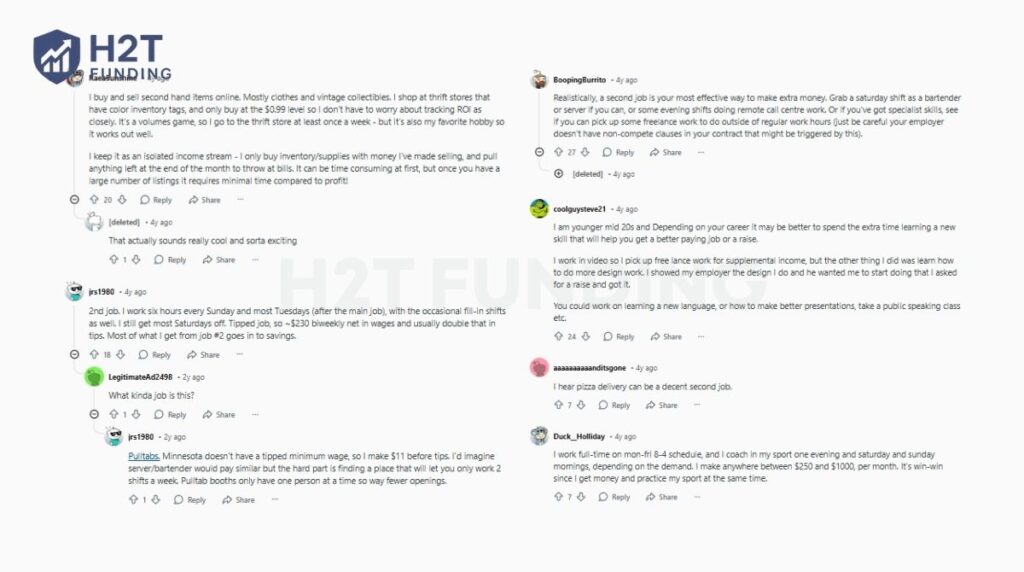
Finally, there’s the entrepreneurial path: turning a hobby or a high-value skill into a real business can be incredibly profitable. I saw examples ranging from flipping vintage clothes and selling succulents on eBay to a car technician earning $100 – $150 an hour for weekend work.
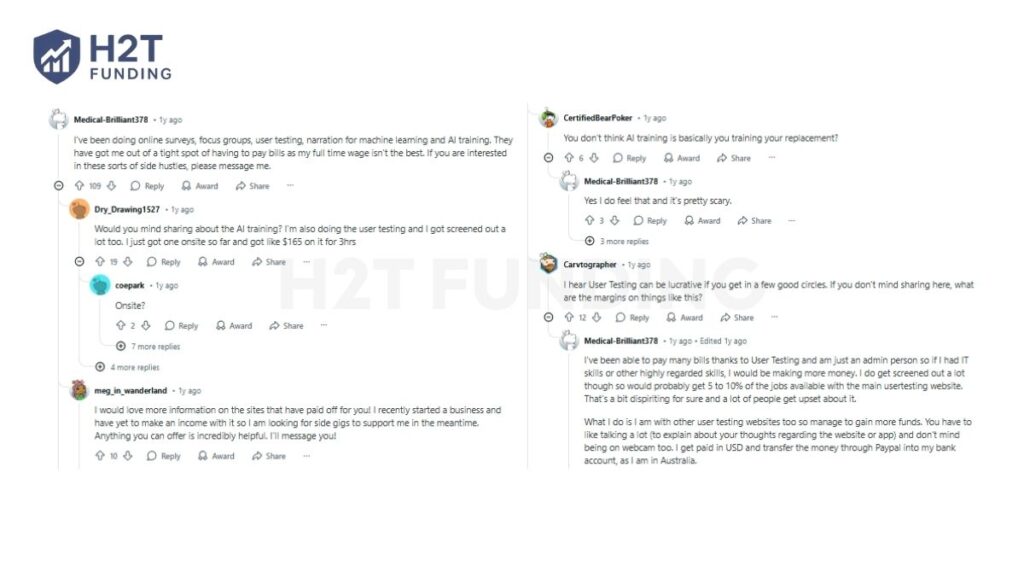
Across all these threads, the single most powerful piece of advice was to find something you actually enjoy, because you’re more likely to stick with it.
9. FAQs
Begin with simple side hustles that don’t require expertise, such as online surveys, delivery apps, or selling second-hand items. As you gain experience, you can develop marketable skills like writing, design, or tutoring to move into higher-paying opportunities.
Yes, many options need little or no upfront cost: freelancing with existing skills, virtual assistance, online tutoring, or offering pet sitting. Even starting a blog or YouTube channel is low-cost, though it takes time before generating income.
Focus on side hustles that fit small time slots, such as freelancing on short projects, teaching one or two tutoring sessions, or doing food delivery on weekends. The key is consistency; even with limited hours, you can still explore how to make extra income with a full-time job by choosing flexible and realistic options.
Yes, most countries require you to declare side income and pay taxes once it passes a certain threshold. For example, in the UK, income above £1,000 must be reported to HMRC, while in Canada, all additional income must be declared to the CRA. Always check local regulations.
The seven streams of income refer to having multiple income sources: earned income (salary), profit income (business), interest income, dividend income, rental income, capital gains, and royalty or licensing income. Building across these streams helps diversify financial stability.
The 50/30/20 rule is a simple budgeting method: allocate 50% of income to needs (housing, food, bills), 30% to wants (leisure, lifestyle), and 20% to savings or debt repayment. This framework ensures a balance between living expenses and financial growth.
10. Conclusion
Ultimately, how to earn extra income while working full-time comes down to picking what fits your skills and goals, rather than chasing the “perfect” hustle. From freelancing to online ventures, there are many ways to make extra money while working full-time if you stay consistent and focused.
Don’t wait until you have more free time; create that time and invest it wisely to build a stronger financial future. For more practical tips on managing money and growing your income, explore our Budgeting Strategies articles at H2T Funding.